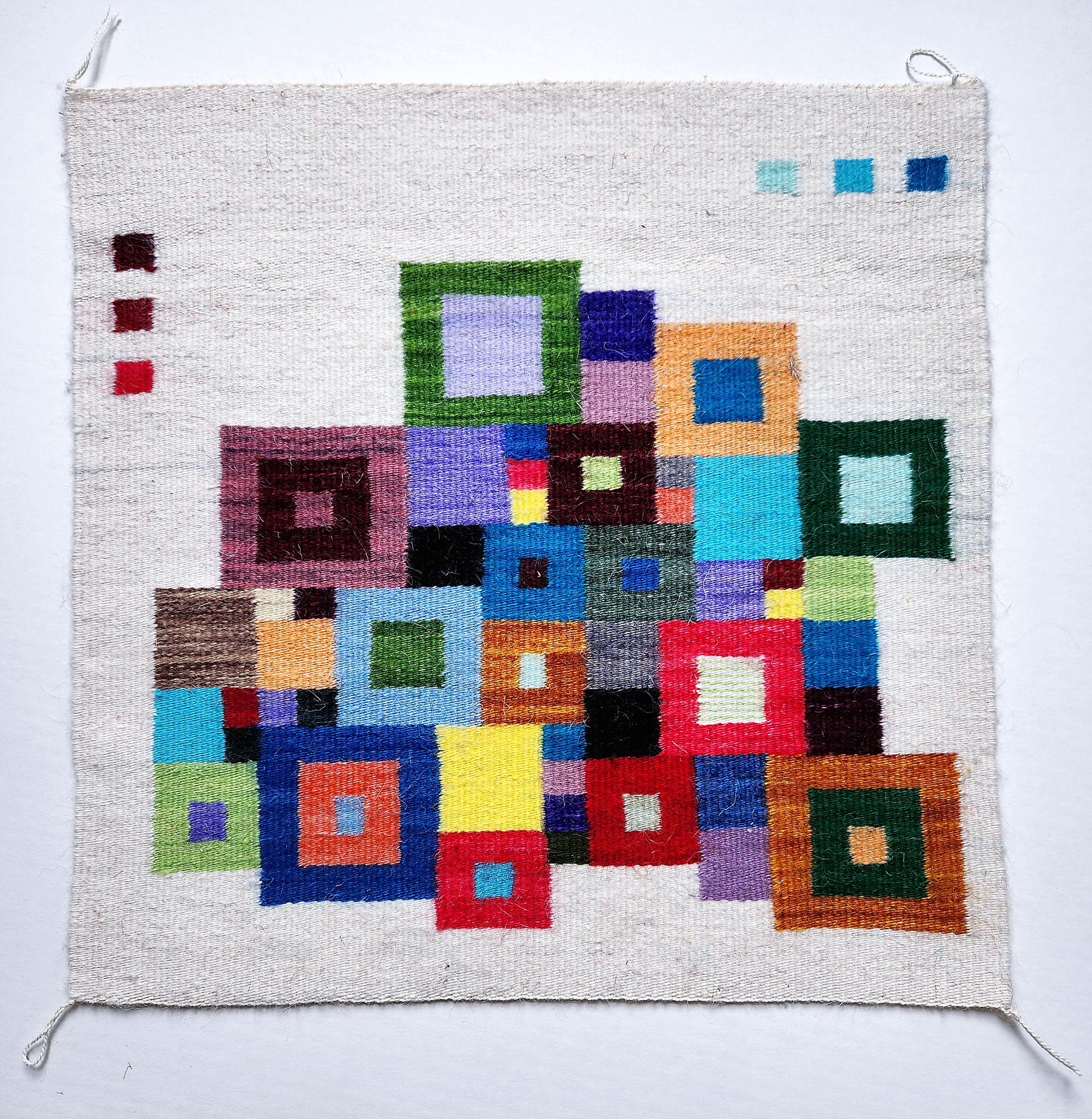
5 Exhibits, 11 Tapestries

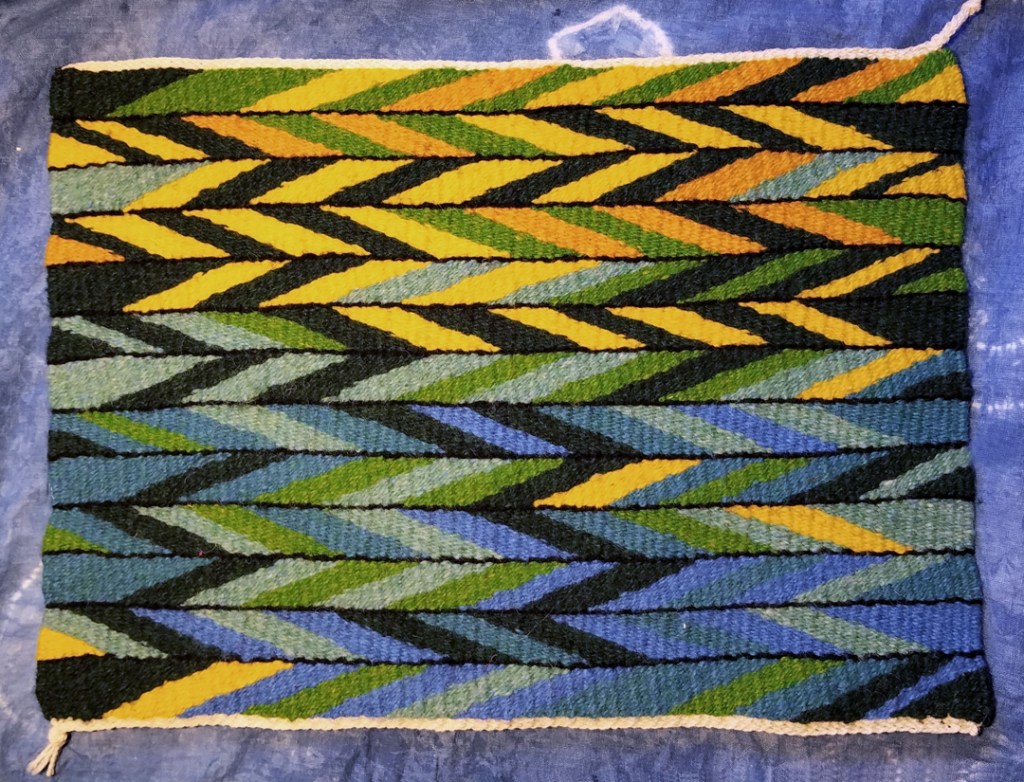
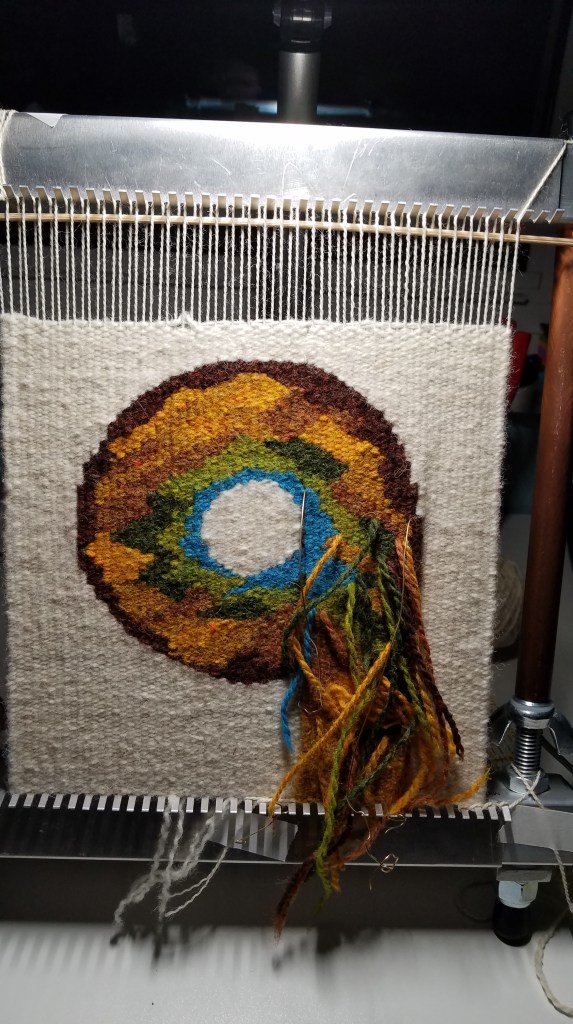
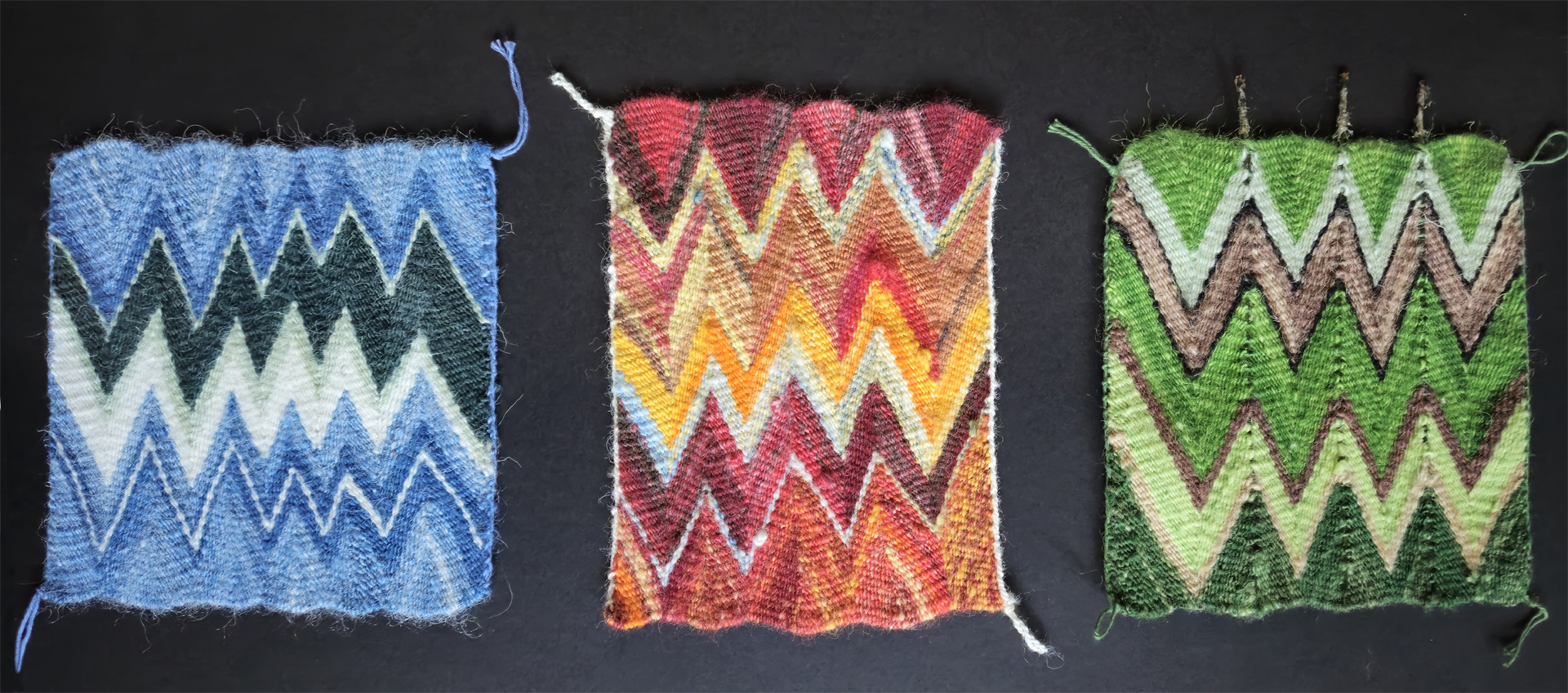
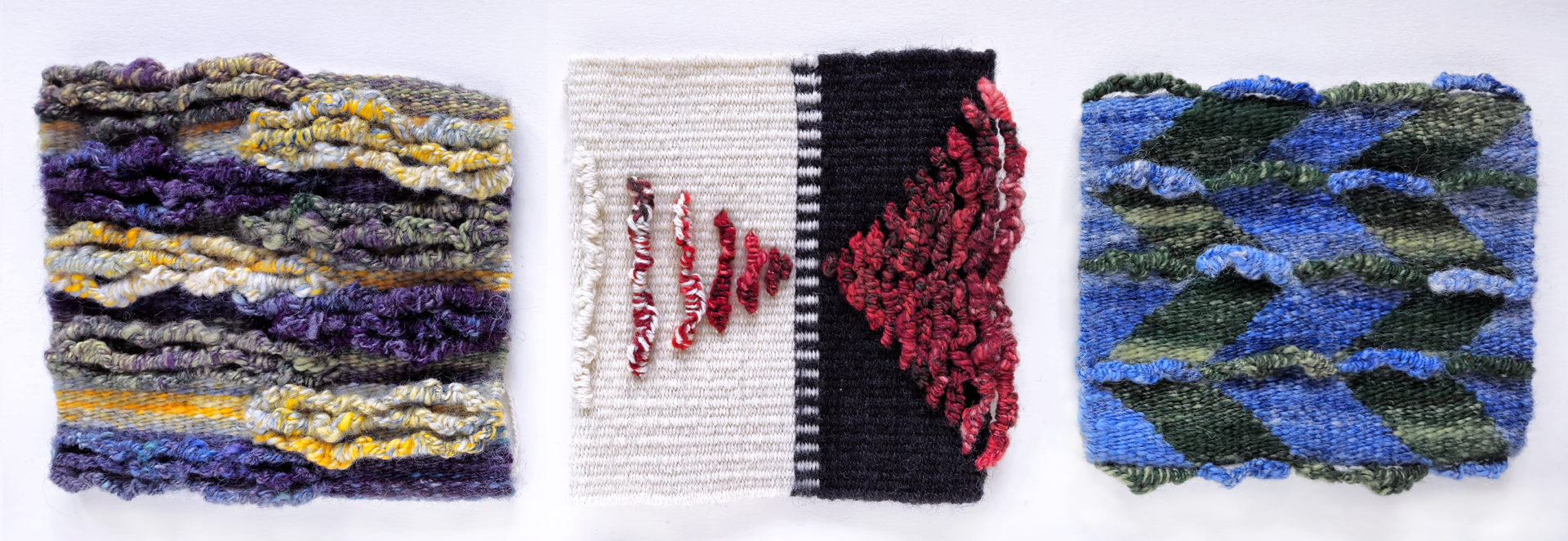
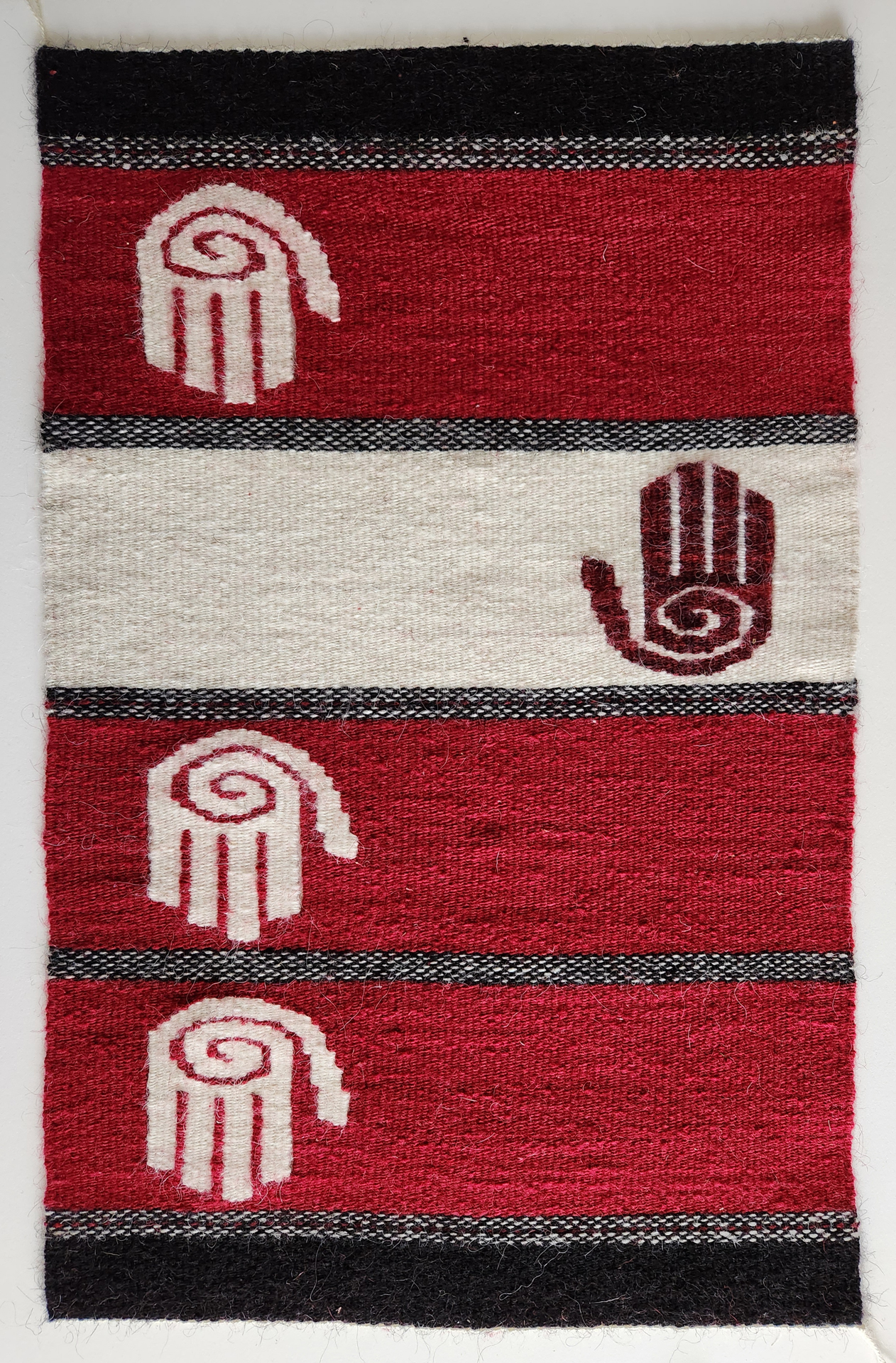
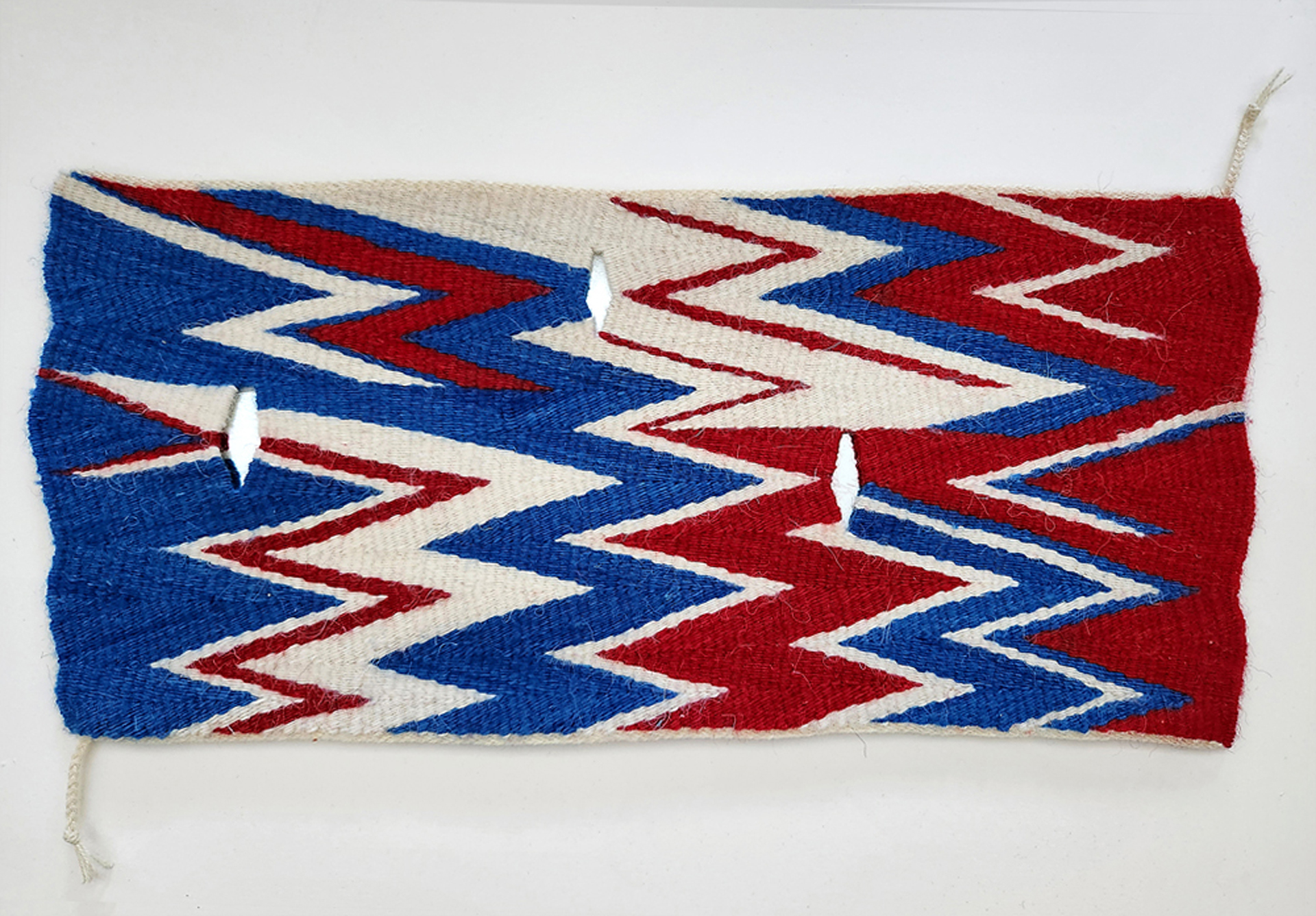
From Top: Earthbound Triptych (Water is Life, Fired Up, Forest Stroll); Communicate Triptych (Missed Communication, Defying Deception, Seeking Compromise); Three Blessings & a Warning; stacked, from top: Divided Threatened Attacked, Missing, Fourth Wave; bottom, Rebuilding.

Whew! June was ablaze with sending work to exhibits: San Francisco, Sault Ste. Marie, Rhinelander, WI, Mount Vernon, IL, St. Louis. Eleven tapestries in five shows.

The month started with three works in the Continuous Thread exhibit curated by the Weavers’ Guild of St. Louis, and hung in the University City Library Gallery. I grew up in this library in the progressive inner-ring suburb of St. Louis. My very first exhibit — and award — was in this exact space when I was 16 or 17, in a community show that allowed teens. I got my very first negative crit at this show also, when a rather smug adult questioned the technique. I never forgot this priggish old man. Comments like that to young people shut them down or fire them up. I guess I should be grateful to him. I was fired up! Three Blessings & a Warning, Missing, and Fourth Wave, all from the Covid Series, hung in the gallery from June 1-27.

Northern National Art Competition selected Rebuilding, also from the Covid Series, for it’s 38th annual exhibit at the Nicolet Art Gallery in Rhinelander, WI. This tiny town in the northwoods seems an unlikely setting for a national exhibit. I’ve been in this show several times and went to the opening in 2023. The large gallery was PACKED with patrons from around the region. It’s an exceptional show and I was sorry I couldn’t attend the opening a couple of weeks ago. The all-media exhibit is open through July 26. You can take a virutal tour of the show here: https://app.lapentor.com/sphere/northern-national-art-competition-2025. If you’re in the Wisconsin north woods, it’s worth a stop.

Tapestry Weavers West mounted a beautiful show, What’s Going On?, that opened in the Mills Building in San Francisco on June 16 and runs through September 26. Divided Threatened Attacked was selected for the exhibit. Tapestry Weavers West is a professional organization of some of the best tapestry weavers in the country — and a few from Europe — though most are from the West Coast of the United States. It’s an honor, truly, to have work among them.

Communicate Triptych (Missed Communication, Defying Deception, Seeking Compromise), is hanging now at the Cedarhurst Art Center in Mount Vernon, IL.. Here is another small town gallery and art center that is beloved by the community. The center mounts a biennial all-media exhibit that draws work from around the Midwest. Again, the reception last Friday was well attended by patrons. Never underestimate the value of art in small towns. The exhibit runs through September 21. The 31st Biennial exhibit catalog can be downloaded or viewed from a link on this page: https://cedarhurst.org/new-semantics-gallery/

And finally, opening tomorrow, July 1, is the Natural Elements exhibit hosted by the Sault Art Center, Sault Ste. Marie, MI. Selected for this show was Earthbound Triptych (Water is Life, Fired Up, Forest Stroll). I love the UP (Upper Pennisula of Michigan) and head to the Soo (as it’s called) whenever we venture north. Yes, we are “holiday Yoopers!” though real Yoopers would roll their eyes at that claim. I’m delighted to have work in this show.

Work doesn’t magically appear on gallery walls. These five shows represent months of applications, waiting for acceptances or rejections (there were a couple in the batch), and shipping off work in the right order to the right place. Record keeping, selecting the right work for the right show, making sure exhibits don’t overlap or work isn’t double-booked, is all part of running a working studio.

We artists are ever grateful for your attendance at a gallery opening, a visit during the show, and even a purchase, which supports the artist and the gallery.

A new round of applications starts this week.

Posted in Exhibits, tapestry, Weaving | Tagged , , , , , | Leave a comment

A Plant, Some Chemistry, & the Sun: What’s Next?

Every art form is malleable. Learn the basics and make it your own. Sun printing, or cyanotypes, is the poster child for malleable. It’s 19th century wet photography that adores experimentation and agumentation, all without AI of any kind.

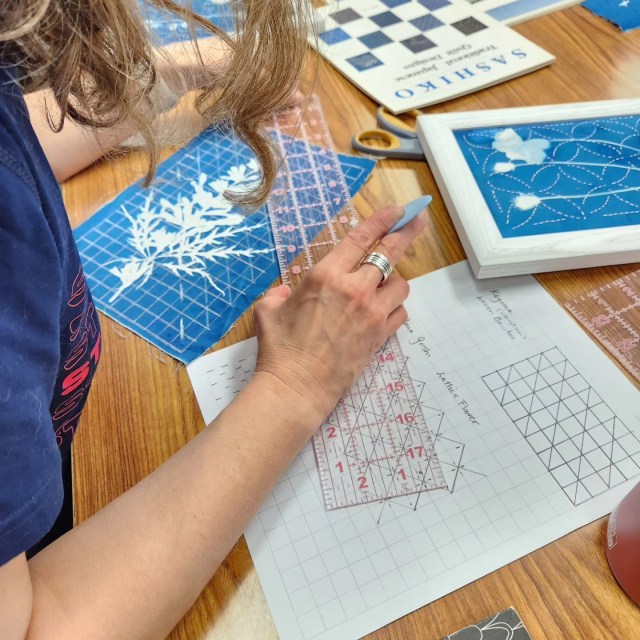
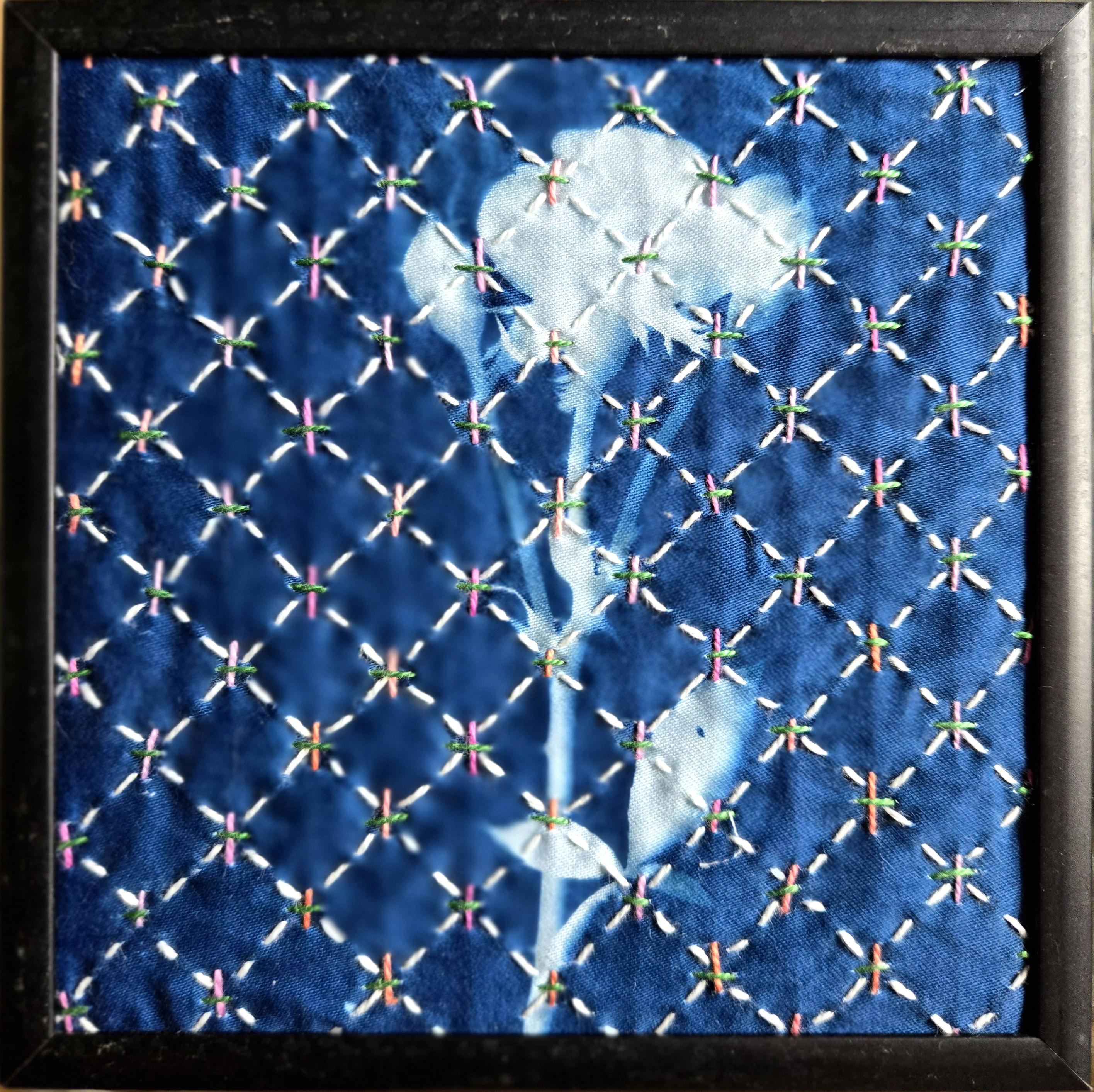
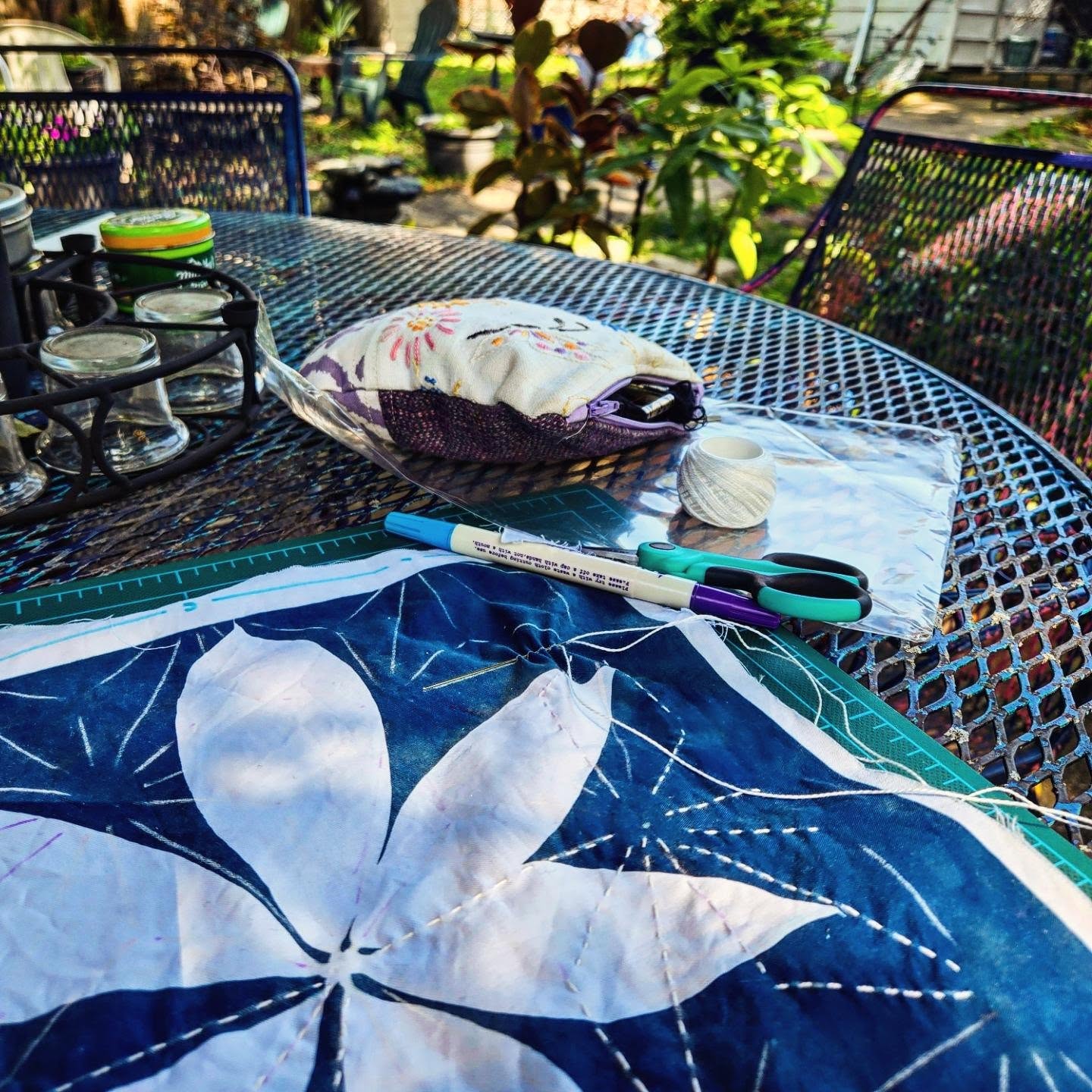
My take on cyanotypes uses plants or negatives exposed on coated cotton cloth, then embellish them with traditional Japanese stitching called Sashiko. (Read the last post about creating cyanotypes here: https://jeanevogelart.com/2025/04/29/a-plant-some-chemistry-and-the-sun/)

Sashiko dates to 17th Century Japan as a way to repair and strengthen home-spun clothing. Over time the patterns became more personalized and standardized. Any color of cloth or thread can be used, but white thread on indigo-dyed fabrics are traditional. The blues of cyanotypes match the indigo traditions well.

The process is simple: a grid is drawn on the finished cyanotype, the grid guides the stitching pattern, and the thread is drawn through. Unlike European embroidery, no hoop is used. The fabric much be gathered in the artist’s hands and pushed into the needle in simple stitches. The fabric moves, not the needle, then the thread is pulled through the 6-10 stitches.

I love the unexpected combination of photography and stitching. It’s especially gratifying to teach this technique: it’s different, though you might have made sun prints at camp as a kid; it’s personal; it’s easy. Everyone can do it.

There’s a health benefit too. Tradition believes that rhythm of stitching the sashiko patterns is calming for the artist, and ultimately for anyone who sees the art.

There is no greater gift we can give in these callous days than calm.

Lattice Rose

Note: I teach this class a couple of times a year in yarn and craft stores, conferences, and guilds. It’s the perfect one or two-day workshop. Email me if you’re interested.

Posted in Art Inspiration, Cyanotype, fiber, Mixed Media, Workshop | Leave a comment

A Plant, Some Chemistry, and the Sun!

I’m a gardener. It’s in my genes. I grew up in a home landscaped by my great-grandfather (Benjamin Widmer, 1880-1958), whom we call a botanist but he was probably just knowledgable and precise with his plants. I have his hand-made concrete birdbath. I have some of his surprise lily bulbs that pop up every year. There have been generations of women in the family who have cultivated the soil for food and beauty.

All of this to say if I can be outside, especially in the spring, I will be. Morning espresso with the birds, dirt under my fingernails from pulling weeds (who am I kidding?), digging, planting, watering, harvesting.

Spring offers the artist the most wonderful opportunities. This year I’m planning a dye garden for my tapestry wool, but first I wanted to chase the spring sun to expose cyanotype photograms. (More on the dye garden later.)

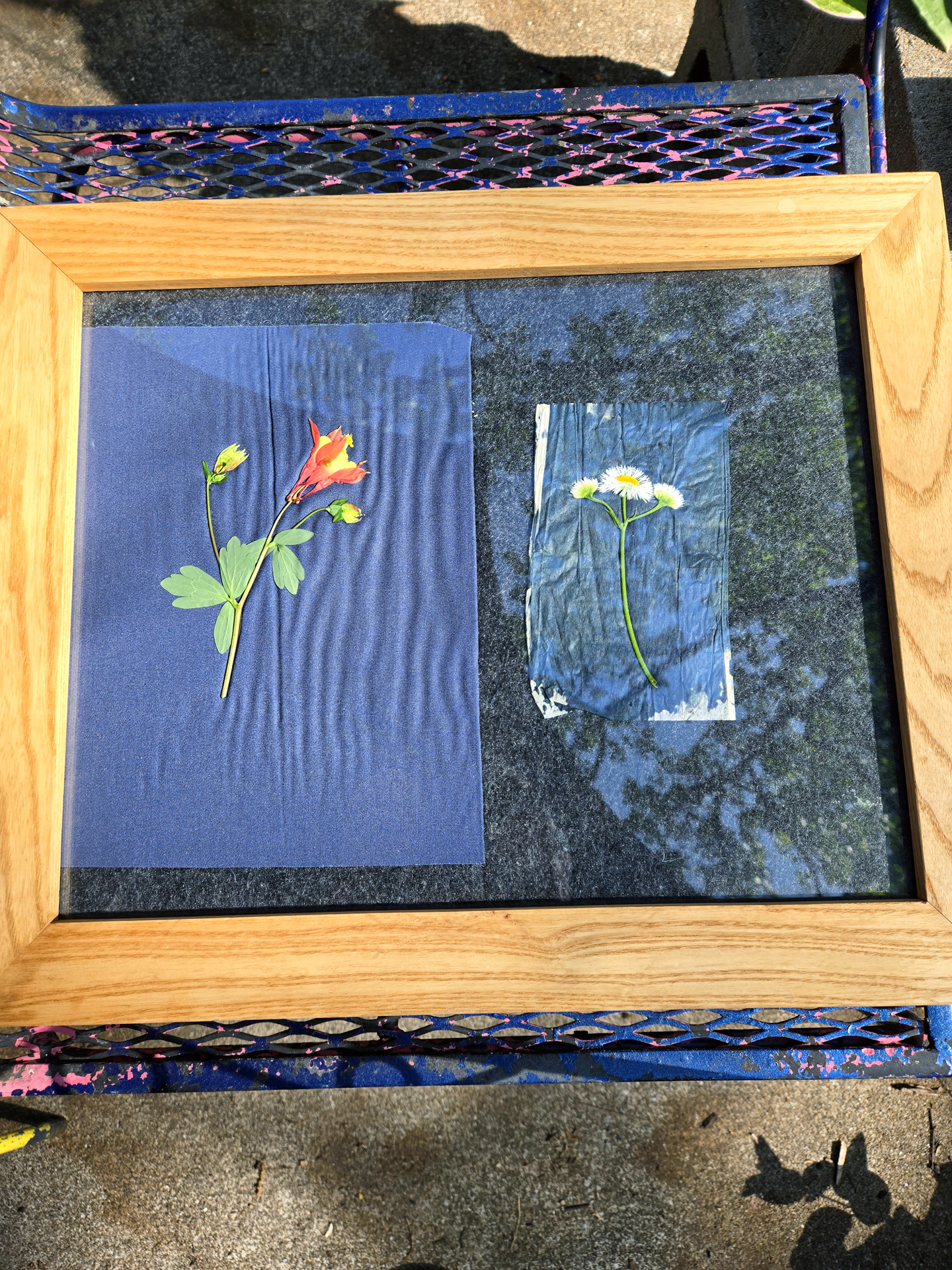
Cyanotypes are the oldest form a wet photography. The concept is simple. Paper or cloth (or even sea shells) are coated with a chemistry. Objects or plants are placed on the coated substrate, then exposed to the sun and developed with water. You might have made “sunprints” at camp. Same thing. That was an introduction to a more complicated and expressive art form.

Spring sun is gentle. It’s the perfect time to create this art. Like all analog processes, it takes time, patience, and little experience and experimentation. The chemistry is science; the exposure is art. A spring exposure is about 13 minutes in full sun. Compare that to 2 minutes in late June or July! Or 45 minutes in December, if you or your materials don’t freeze first!

St. Louis in April is unpredictable. Rain, tornados, frost, blaring heat — sometimes all within 24 hours. To make spring art outside you have to watch the weather, have your materials prepared, clear your calendar, and GO! The new growth in spring is irresistible! The sun is elusive!

Yesterday was the day. Rain for days before, predictions of storms after, but there was a window. There was talk of clouds in the afternoon, so morning it was. Excellent. Cool but sunny.

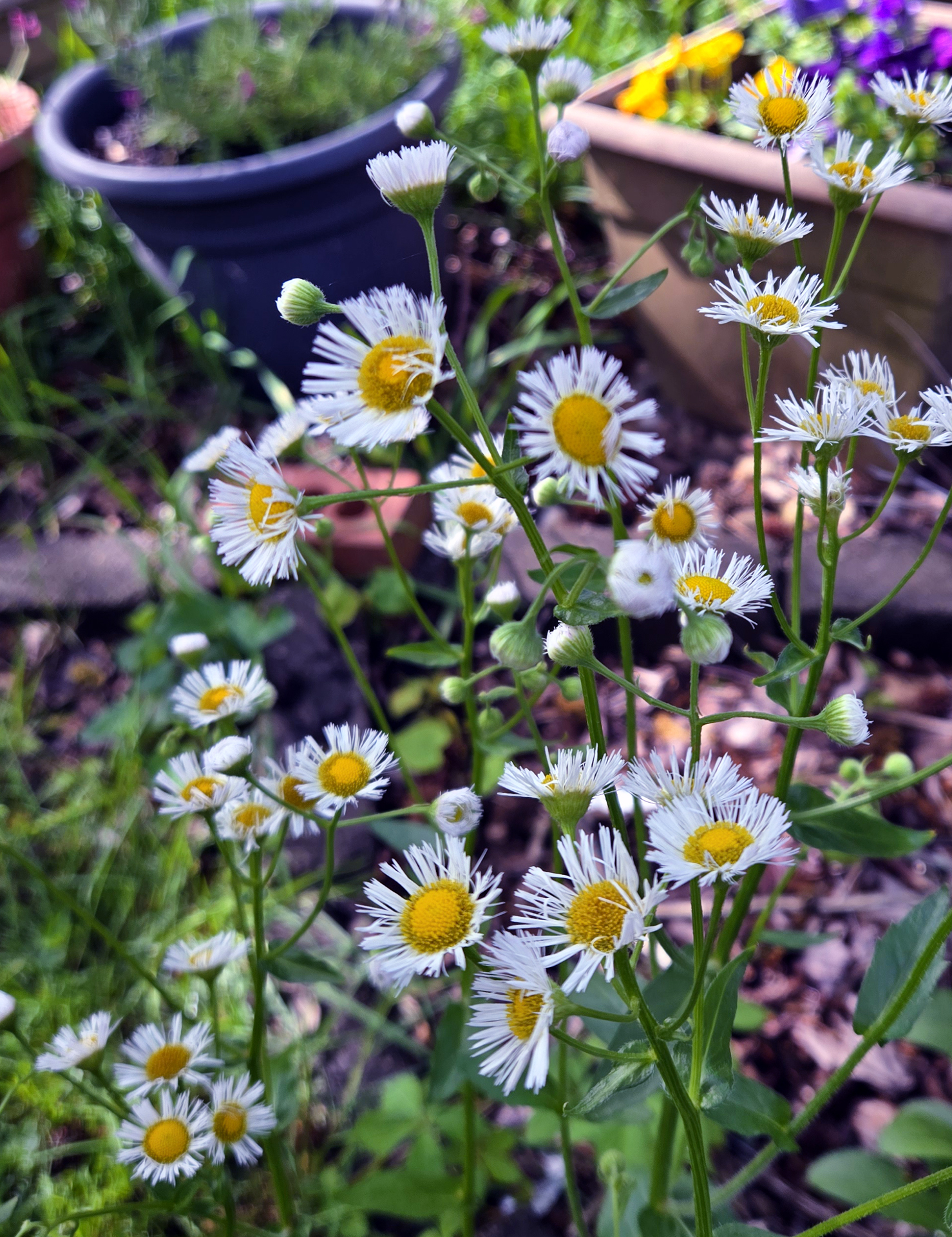
A quick stroll around the yard offered daisy fleabane, columbine, lavender, pansies for the exposures. I have pots and pots of ferns, but those can wait until spring flowers are gone. The day before, while it rained, I coated some tea bag paper with the chemistry, and found some scrap cotton to work on. I had saved several dozen used tea bags, dried them, opened and emptied their contents, and cleaned them. The paper is delicate and transparent.

I had plans in the afternoon, so a full morning of work was planned. Gather the plants. Arrange a composition in diffused light. Close up the contact frame that holds everything in place. Open it up again to fix materials that shifted. Find the spot that has unfiltered sunlight. Move it again. Time it. Check for exposure. Removed the exposed paper or fabric.

Here’s the real magic of cyanotype: pop the thing in water. Plain water. Watch it develop. No darkroom needed. A shaded part of the yard is fine. Over the course of minutes, a photograph emerges, and darkens and improves as it dries.

Art is found in a backyard garden and 19th century chemistry!

Next time: let’s stitch the cotton cyanotype with some sashiko stitching!

Left: Columbine on older coated cotton, and daisy fleabane on freshly coated tea bag paper in the contact frame soaking up the sun. Right: A morning’s work drying in the stiff breeze, hence the rocks!

Posted on by jeanevogelart | Leave a comment

Artist’s Journal: Alone

There are things you notice when you are alone in the woods for any period of time, when there are no radio or tv sounds, no one else talking, no distractions.

You notice the sound of the land.

In the spring, the shoots pushing through the earth are almost audible. Rain hitting the path has a comforting tap. Barks from dogs racing through the woods after squirrels or rabbits or a fox are amplified.

In the fall, there is a “puff” as leaves separate from their branches and join the debris on the forest floor.

At first, it’s another background sound, softer than bird calls or distant highway noises. Soon, without a breath of breeze, one lands at your feet. There is a soft crackle as it settles. The leaves are falling, layer upon layer, one at a time, until the ground is no longer green with moss or grass, but brown. Textured, crunchy. Home for special insects until spring, then decaying to nourish the soil.

The leaves are falling.

Watching them is one of the gifts of alone.

Posted in Art Inspiration, Nature, Residency | Tagged , , , , | Leave a comment

Artist’s Journal: Ok. What is that?

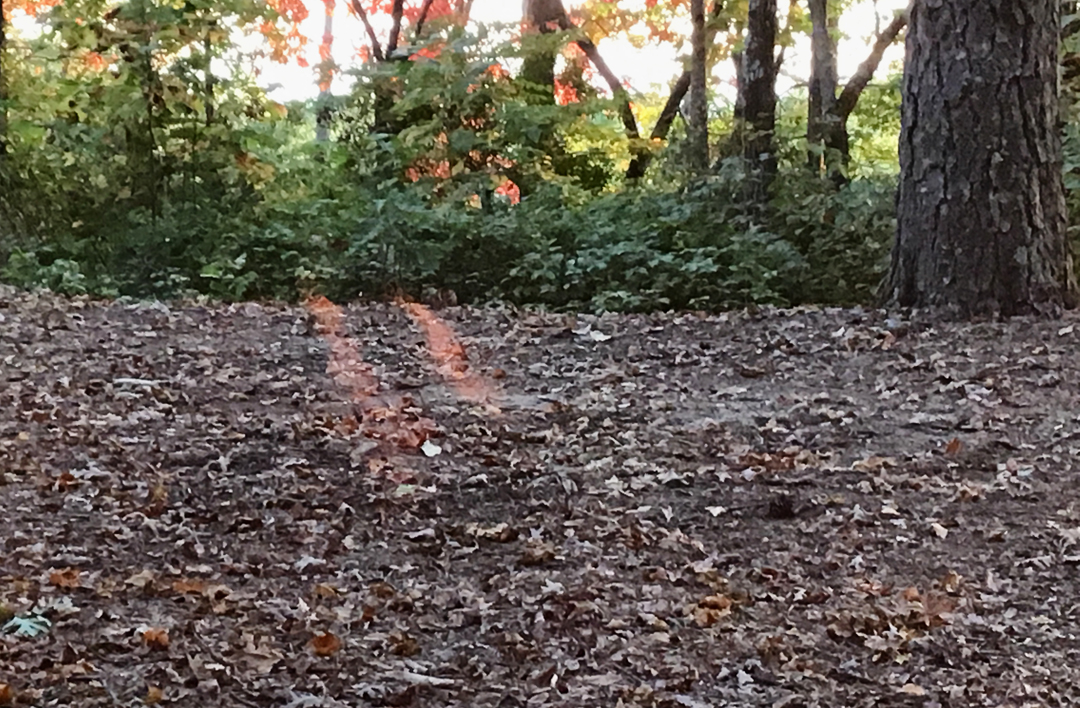
Traffic orange stripes? Wait. What?

Morning coffee on the deck. Late afternoon tea on the deck.

The view from my cabin at the Lillian E Smith Center is simple but stunning. I quickly developed a routine of enjoying the view as I contemplated the start and end of the day. The vista is takes no time at all to be familiar. Trees, mountains in the distance. Falling leaves when it’s breezy. Quiet in the evening.

The routine is eye-opening on brisk mornings; serene in the evening as the air cools and the day settles. The sun sets very quickly behind the mountains. There is enough light to read one moment, only to struggle to see the page that is coated in an orange glow moments later.

Two evenings ago I looked up from my book as sunset neared and saw two short, straight, parallel “traffic orange” stripes among the leaves. I am completely alone here. Bill, the caretaker, drives by every day or so and asks if I need anything. Everything is great, Bill. Thanks. He is gone. No one has been here. How have I missed this?

Even if I am walking along the road or hiking the paths, (watching for one of the six venomous snakes indigenous to these parts; I hate snakes) I would have heard a car come by. Tires crunching the gravel road is a sound that carries. It’s too far from town to walk. What has happened here?

I walk over to the stripes and cast a shadow on the ground. The orange disappears. If it’s not paint, it’s light. What is reflecting the color?

Back on the porch I notice there is a very red maple tree about 5 meters down the hill. The sun, just at the top of the mountain that will obscure it shortly, has backlit that tree. The tree is acting as a reflector. The intensity of the light on the red leaves strikes the ground at a 45-degree angle to display the two orange lines.

I’m an artist, not a scientist. I understand how light plays with colors but I cannot explain the physics. I don’t need to.

One of my goals of residency is to slow down. To think more deeply. To SEE more deeply. To add quiet to my work.

Those two stripes, created by light and angle and intensity and leaves that lost their chlorophyll, have not been repeated any evening since. If I hadn’t been open to seeing something new at that moment, I wouldn’t have known it existed. Now, that reflection — or whatever physical name it has — is part of the gift of this artist residency.

When people ask me what an artist does during residency, this will be one of the stories told.

Setting sun on the right, red maple on the left. And those orange stripes on the ground.
Posted in Art Inspiration, Inspiration, Light, Nature, Residency | Tagged , , , , , , , , | 1 Comment

An Artist’s Journal: Residency During Pandemic

How can artists make a living during pandemic? How can we sell our art? Those are the most common topics of discussion among artists I know these days. The second most common topic? How can I create amidst all this chaos and uncertainty?

Not every artist feels a paralysis of inspiration, but most of us — artist and civilian — know the sense of unease, uncertainty, and heightened anxiety that 2020 has dumped on our heads and hearts.

Respite for some can come in a weekend away in a safe place. For artists, the answer often is a residency. Some residencies are collaborative, working with other artists and the community. Some are solitary, dedicated to work and reflection. Both are restorative and inspirational. Both are vital to my practice.

Before pandemic, I applied for 2 weeks at the the Lillian E. Smith Center in the Blue Ridge Mountains of northeast Georgia. (I will write about the remarkable Lillian Smith later this week.) I wasn’t sure I would be able to go when the time came. Would it be open? Would I be brave enough to leave the home bubble? The Center is isolated and no more than three artists are in residence at a time. The benefits of the residency were worth the risk of travel (by car from St. Louis) and time away.

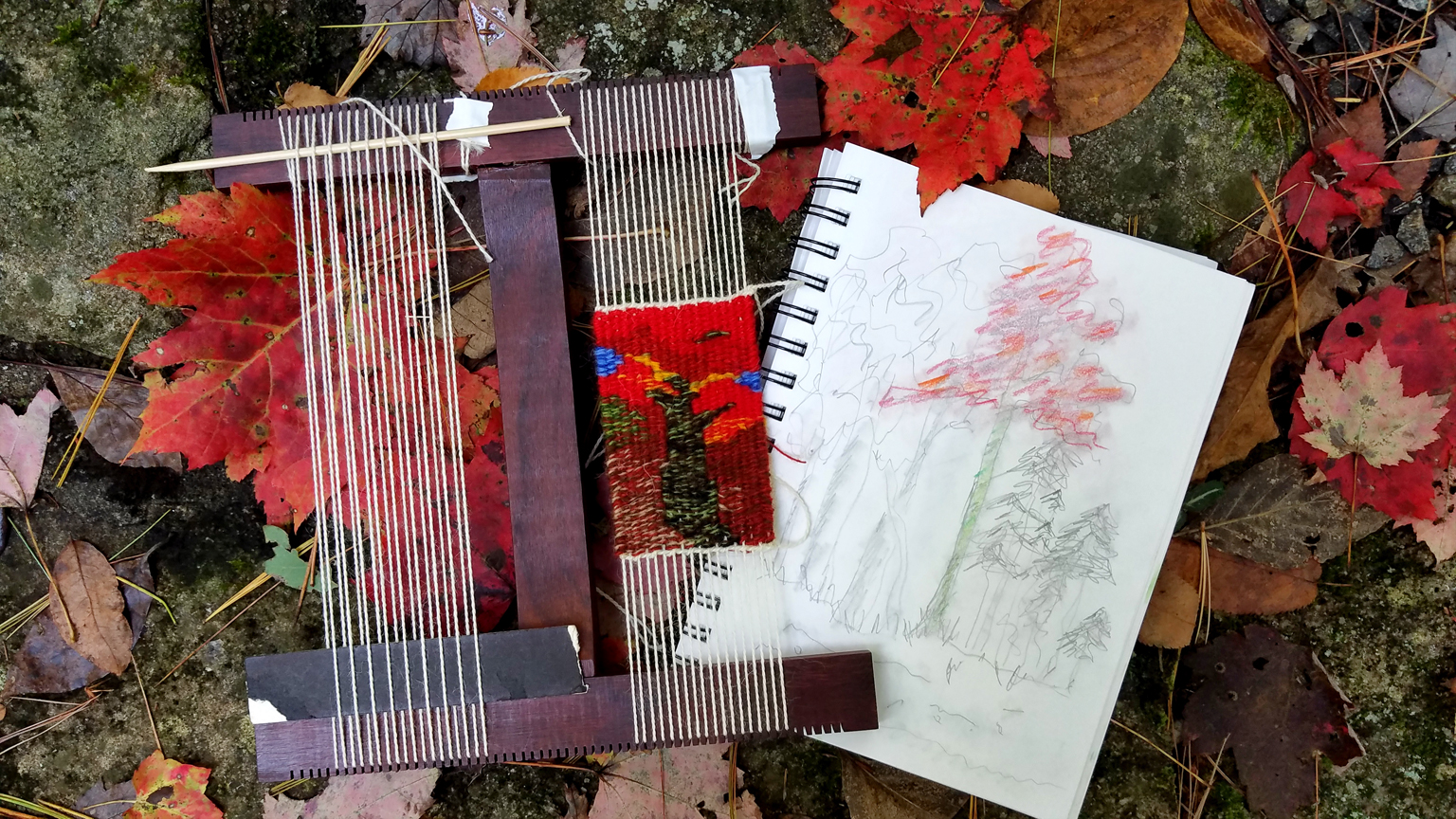
A quick pencil sketch and subsequent small tapestry weaving. Work of Day 1.
Red Maple, 3.75 x 2.5 inches, wool warp & weft

For me, the key to a successful residency is to quickly decide on and establish a work/living routine. I open myself to the sense of place. Sit with it. Walk with it. Listen to it.

I arrived Sunday night in a light rain. Monday morning, yesterday, the trees were dripping with the last of moisture as the clouds cleared. There are four rocking chairs on the covered porch from which to choose. With a cup of coffee, a journal, a sketchbook and some pencils, I sat to take in the first day.

The colors in the morning after a rain are particularly vibrant. Among the hundreds of trees in my immediate view were oaks, hickories, and pines. A solitary maple, bright red, stood among the yellow and brown leaves and green needles.

I made several quick sketches, simply to get a sense of place and to slow down my normal frantic pace. I didn’t have obligations to meet, no meals to cook, no work to deliver, no Zoom calls to log into.

The red tree went from sketch to quick tapestry on a small loom. For me, the first day of a residency sets a tone, a pace, an expectation. A finished work is not required, but this little tapestry was done by evening. I wove it “free style” rather than using a cartoon — what tapestry weavers call a drawing that is placed behind the loom to guide the weft yarn placement. I used scraps of yarn I brought, blending them in small bundles to get the effect I wanted.

My tapestry practice is graphic, rather than representational. I don’t reproduce a scene or a picture, but explore concepts in color, shapes, symbols. A combination of the two approaches came together in the tapestry of the maple: a play of color and form suggesting — rather than depicting — the scene.

Exploring concepts, rather than reproducing life as it is seen, seems to be an appropriate analogy for an artist’s residency during pandemic. It’s not “normal” but it is possible to use the tools at our disposal to see new possibilities and improve upon our work and lives. It’s time to think more deeply.

Posted in Art, Art Inspiration, COVID-19, fiber, Inspiration, Nature, NewWork, pandemic, Residency, tapestry, Travel, Weaving | Tagged , , , , , , , , , , | 1 Comment

A Winter, A Spring, A Pandemic, A Tapestry

Remember late December 2019? Finishing holiday celebrations of our given traditions, settling the year’s accounts, looking forward to 2020. The Damocles’ Sword that hung over us was Climate Change — not Pandemic.

It was climate change that was on my mind as some tapestry friends came the end of their annual tapestry diaries and started planning new ones. Tommye Scanlin* is the master of this durational art form. The idea is to weave something of a diary entry every day. Some people use it as a daily art discipline or as a visual journal entry. I chose a third path: the year documented as art.

Actually, the idea of the daily tapestry journal didn’t appeal to me but I was starting to feel a little peer pressure to get started as New Year’s Eve neared. Artists are a pushy bunch.

Here in St. Louis, our winters are warming. Our summers are hotter and more humid. Our rivers flood more often. Our storms are stronger. A freak, unexpected derecho storm wiped out — and I mean FLATTENED — an art fair where I was exhibiting in early September 2018. The cost of the climate crisis was on my mind.

Daily temperature charting and the NOAA temp color chart I used as a guide, with yarn samples as a guide.

Science is the flip side of art.** Many of us artists approach our work from the left side of the brain also. The idea was observe the natural world, chart the daily high and low temperature, and weave those facts into art.

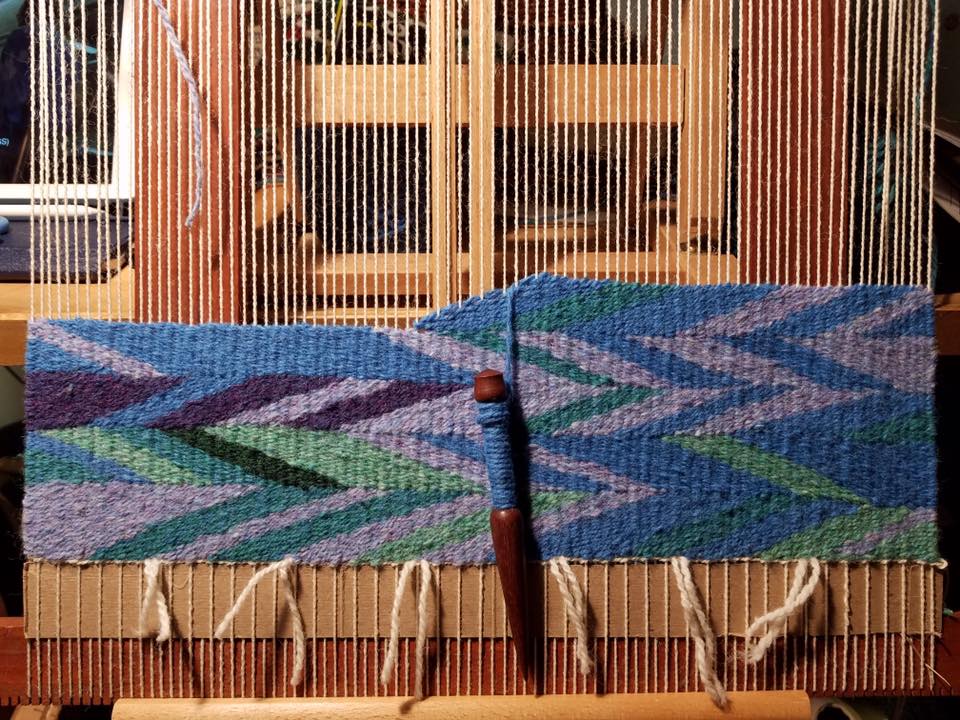
Weave it how? Some use squares, which can leave dramatic slits between the days. Some use trapezoids to hold the piece together. As with all art, the technique and craft will determine the success of the piece.

Then the answer arrived: wedge weave!

Wedge weave is a tapestry technique developed by Diné weavers (Navajo) and practiced from roughly 1870-90. Most woven fabrics follow a grid that connects warp (vertical threads) and weft (horizontal threads) at right angles. The Diné chose 45 degree angles, weaving on the diagonal. Kevin Aspaas’s work is a great example. It fell out of favor because white rug purchasers, upon whom the weavers depended for sales, didn’t like the scalloped edges. Gratefully, the style is making a resurgence.

Wedge weave is an art form that is connected to the earth, and honors a nation and culture without taking their designs. It fits the concept.

The work started simply enough. One week recorded per section of wedges. The January temperatures were unseasonably warm, then dipped a bit. Science recorded in art. That appealed to me.

Every day of January 2020 daily high and low temperature recorded in wedge weave.

Then we came to March. Pandemic. Lockdown. Illness. Friends in New York dying. I attended three virtual funerals in as many weeks.

Most of my work focuses on interpretation of symbols. Everything means something. That something adds to the depth and understanding to the art. Art is communication, after all. I only consider my art successful if it stirs an emotion, triggers a memory, evokes a response. The immensity of COVID-19 demanded a voice in this work that documented a year. Two passes of black wool, woven horizontally, separated the weeks and marked the pandemic. COVID-19 had a place in the work.

What about those braided edges? Do they have a meaning? Of course. The braids represent the binding of the people to each other just as the days bind together into weeks and months.

The discipline of the daily practice that will take a year can be wearing. Facing exhibit deadlines on other projects, the temperature diary fell behind. April-June was finished on September 2. I thought I was done. I don’t need to finish the year. Then I took it off the loom.

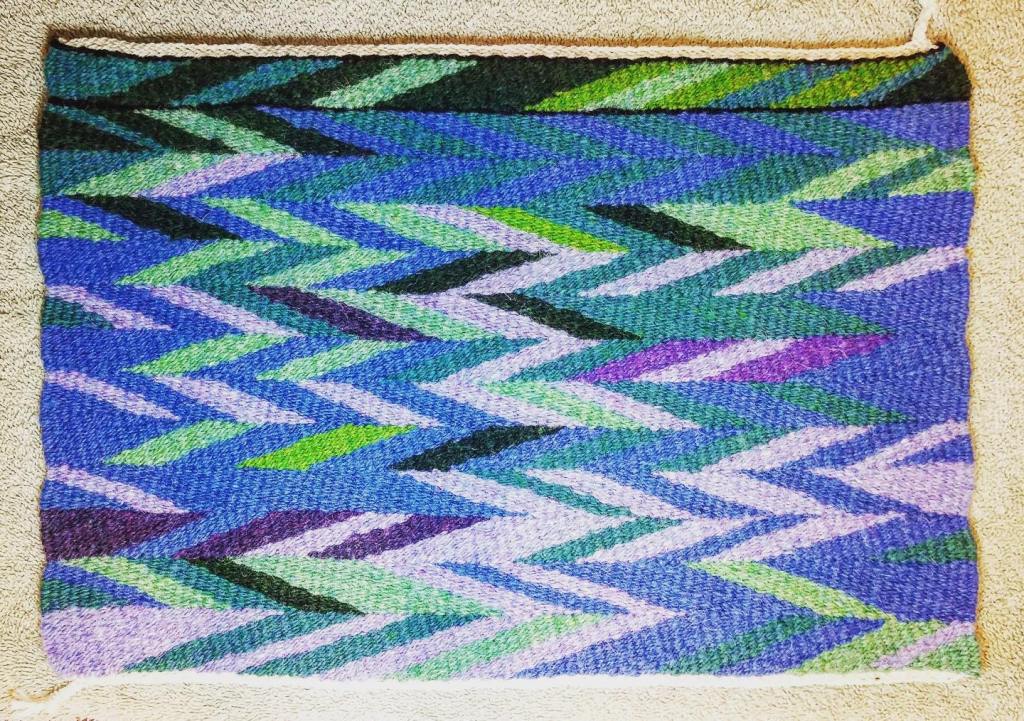
January – March daily temperature diary, read from the bottom to top. Last two weeks of March, at the top, rimmed in black to represent the impact of the Pandemic. 11×15 inches. The scalloped edges are characteristic of the wedge weave structure, which distorts the selvedges as the wefts pull against the warp.
April – June 2020 daily temperature diary. Each week rimmed in black. 11×15 inches.

Work on the loom or the canvas on in the camera is work. It’s the task at hand. The work is the craft, the doing, the intention. As I am often heard to say, “artwork is WORK! It’s a WORK of art, not a play of art. Work!”

Off the loom the work takes on a completely different dimension, an importance that didn’t appear until the warp ends are braided and the ends finished. The work becomes art — or not. More than an exercise, the temperature diary marks an extraordinary year. It is a documentation of what we are living through. It deserves a conclusion.

I’m two months behind but I will catch up. I had another plan for that loom, but it will be warped up again for a testament to a summer in pandemic. July-September will be followed by October-December.

I long to remove those black lines.

To be continued…

*Please visit Tommye McClure Scanlin’s daily tapestry journals here, and spend time with all her extraordinary work.

**Read my blog post Art, Your Cousin is Science here.

Posted in Art, COVID-19, fiber, NewWork, pandemic, tapestry, Uncategorized, Weaving, Wedge Weave | Tagged , , , , | Leave a comment

Winged – A Symbol Takes Form

As an artist, I work in a variety of disciplines. I’m mainly known as a photographer because I’ve done that the longest and sold thousands of works through 20 years of art fairs and gallery work. Ceramics, fiber, mixed media painting, and most recently tapestry are included in my art practice. Every discipline requires study. More importantly, every discipline demands practice. Lots of it. Over and over and over.

Learning a new media starts with the basics. Learn a technique. Put it to work. Most students learn by copying others. Moving beyond copying to finding your own voice and style is the path to artistry.

At the end of the last century, about a year into my ceramics study, I was struggling with a form. I asked for advice. The teacher told me I was at a point when I needed to reach down a little deeper and find the answer myself. “When you can take an idea and make it a “solid,” you have reached the first level of mastery. You won’t progress until then.”

What a challenge! She was (and still is!) a good teacher. That’s where I was with “Winged.”

For the last several years I have been exploring symbols from different cultures and different eras, and marveling at how humans have used the same structures to represent ideas. Peoples who are tens of thousands of years apart or tens of thousands of miles distant have used the same symbol to convey the same idea. Our DNA remembers and reaches back hundreds of thousands of years. The symbols unite us.

I chose tapestry for this series because it is a tactile medium, a forgiving, medium, a challenging medium. It uses spun fiber, which women have been doing, in much the same way for maybe 40,000 years. Weaving is a woman’s art. I stand on the shoulders of thousands of generations of grandmothers and aunts. It connects me.

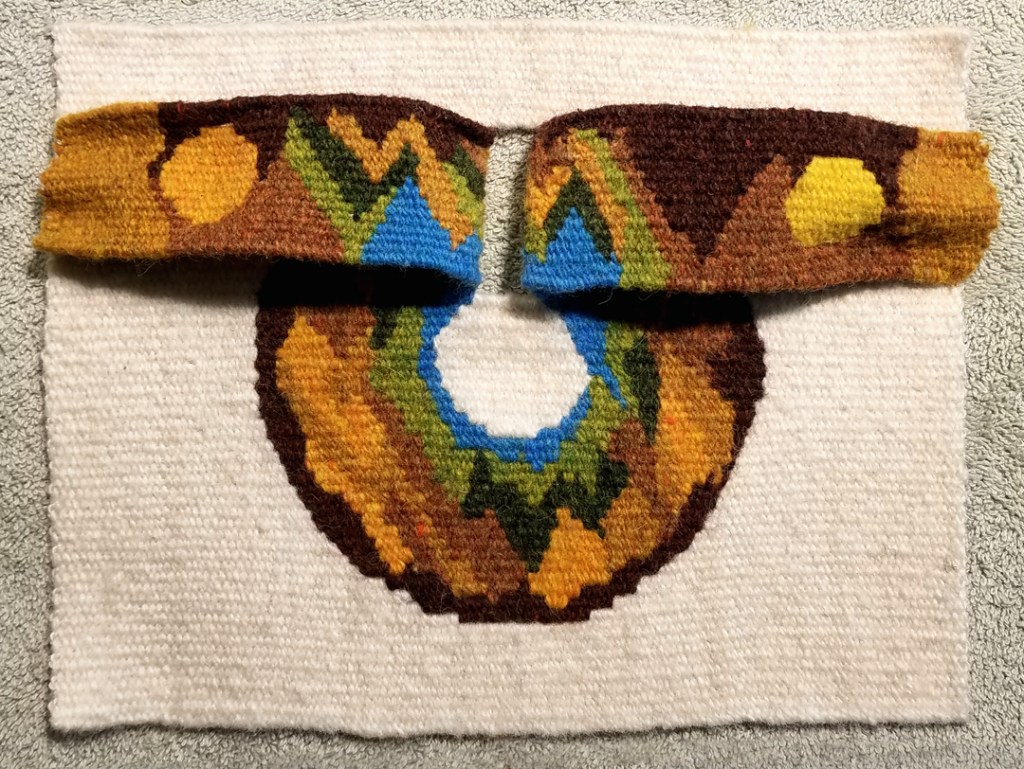
“Winged” is inspired by the Maori object Kākā Paori, a ring that fits around the leg of a kākā bird and is used to tame it. Stylized it can represents the character of the bird. It is intricately carved of stone and valued as a heirloom. In many cultures birds represent the connection between the humans and the sacred, wisdom, or freedom.

I wanted to take this simple ring, sometimes represented as a “C” on it’s back, and create a representation of a winged bird. I knew three things: it would be woven side to side, it would be 3D, and it would need a supplemental warp. Supplemental warp was new to me, and I didn’t have a teacher for it.

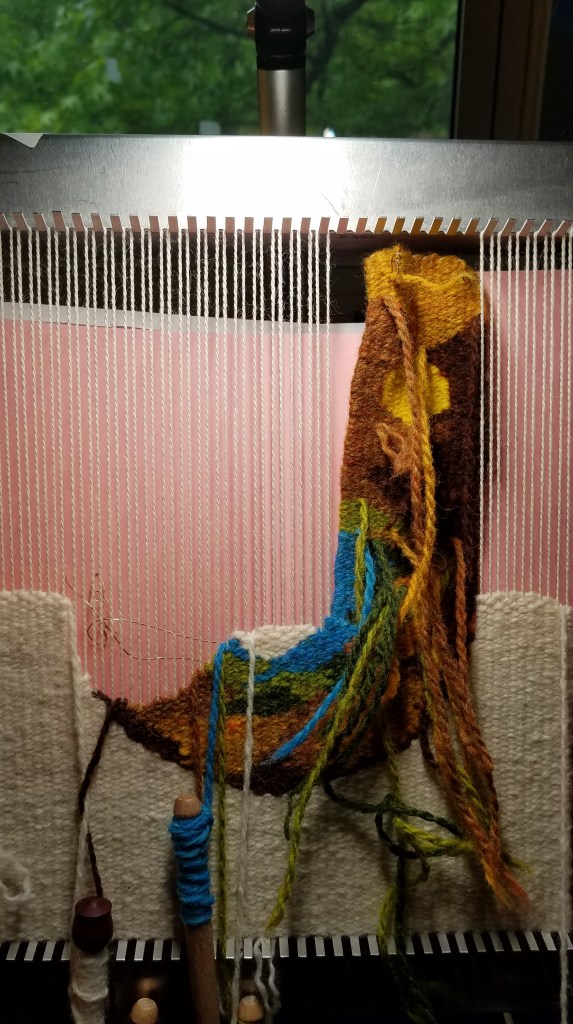
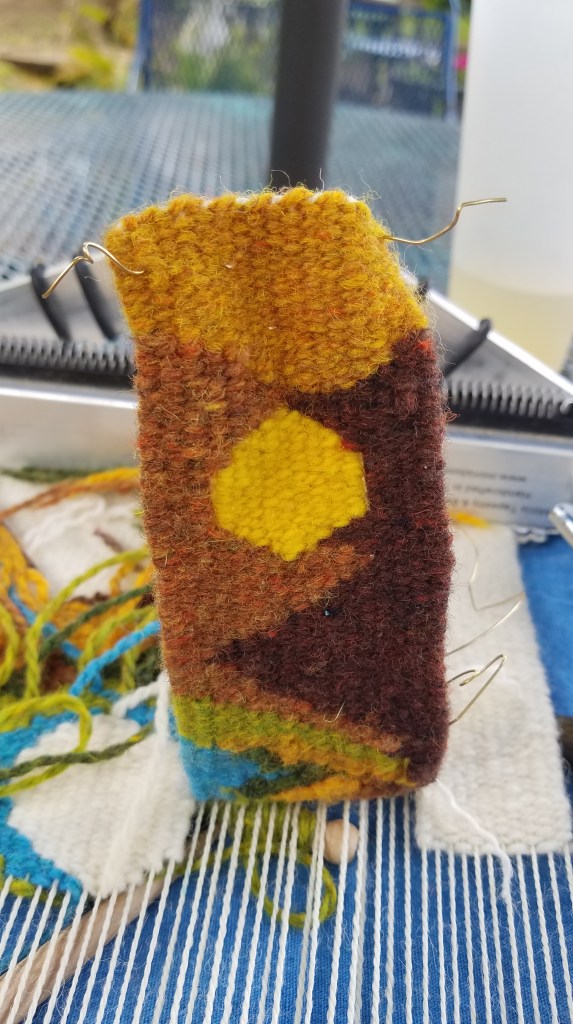
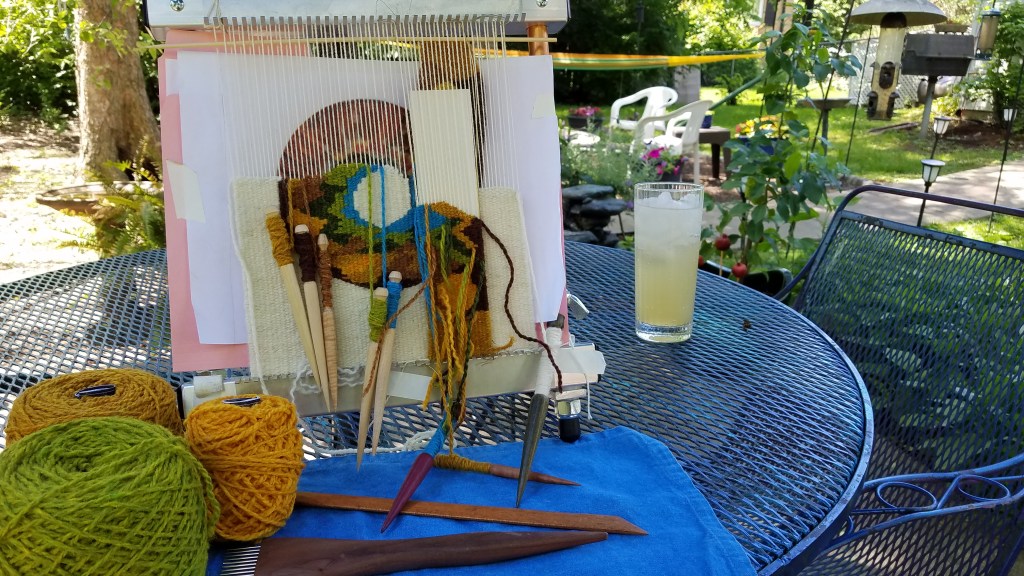
The images below show the progression of the piece and the completion of the first wing.

Note that I was weaving from the front until the wing started taking shape. Since it would be folded over, I started weaving from the back to keep the ends on the proper side. The cartoon was used only for shaping. The weaving was free form. I added colors and shapes as I went, using a rough idea for how I wanted it to look. The idea of free form weaving gave it an organic, natural feel.

Finished, mostly. 8×10 inches. Wool warp and weft. 9 epi.

“Winged” was one of those projects that I figured out as I wove it. I knew it was possible and understood the basics in my head but had a hard time visualizing it. Of course, it seems simple now.

Lessons learned:

— Supplemental warp and 3D pieces are intriguing. I see more designs in my future.

— 22 gauge wire is too small to support the wings, which need to be tacked down. It is strong enough to give it some shape.

— The Shasta Combs on the Mirrix make this project easier. Supplemental warp can be challenging. The combination of the combs and the tensioning device on the Mirrix made it easy to release the warps, tighten the loom and rewarp it. (I don’t represent Mirrix Looms, just use them!)

–Don’t overthink the design. I spent far too much time trying to figure out how I was weave this — more than the weaving itself, I think.

There’s still lots for me to learn. My circles aren’t what I want them to be, nor are my selvedges. The trick, of course, is weaving, weaving, weaving! And don’t be afraid to try something new.

Posted in Art, Nature, NewWork, tapestry, Technique, Weaving | Tagged , , , , , | 2 Comments

An Artist’s Journal, Ireland: The Sea

There are people who spend their holidays in cities. The nightlife, bustling streets, museums, people-watching, top-rated restaurants.

There are people who crave the land. They hike through mountain passes, through meadows of wild flowers and brambles, skinny-dip in cool lakes, light safe camp fires in the evening and pull comforters around them against the dew as they retell old stories.

Then there are sea people.

For each, something in that place, in their soul, pulls them in. The sea is mine.

Ireland is an island. Of course there is sea. On the east, the Irish Sea is rustic, waves crashing against rocky crags that emerge and submerge with the tide. The sun rises, tinting it pink.

On the west, the sea is majestic, strong, relentless. Angry waves, pulled from the New World, crash against the cliffs. Gentle water laps on the beaches. Ireland is not a land of sunbathers. The water is cold, the air is damp, the skin is very, very pale.

Beaches are for walking. Cliffs are for contemplation.

For this artist, nothing is more difficult to capture than the sea. A photograph does not whip the wind, forcing the jacket closed and the scarf wrapped tighter. A painting cannot scent the air. A drawing lacks the colors.

Nothing contains the sea.

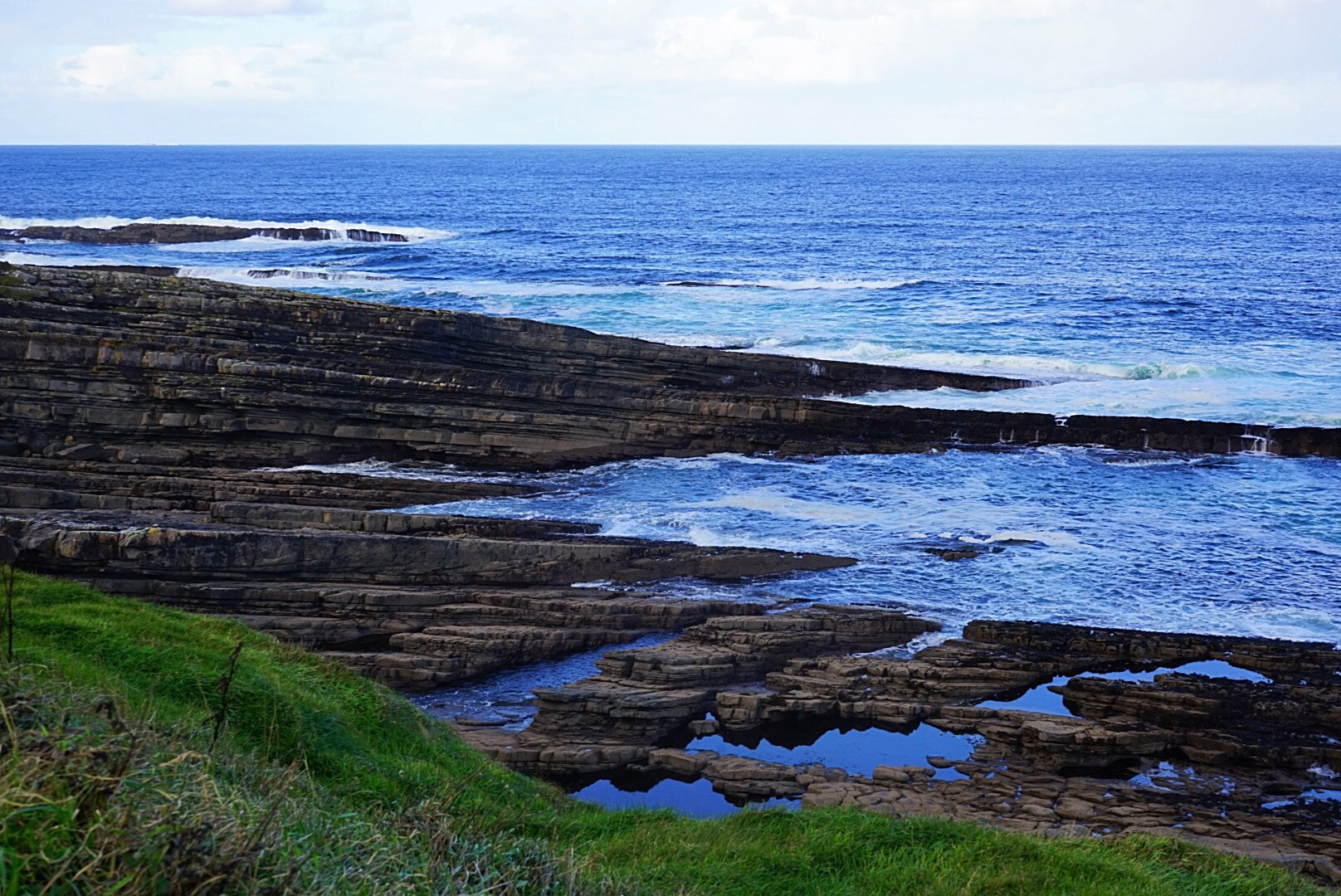
Photo: Cloonagh Cliffs, Sligo, Ireland. ©Jeane Vogel Studios

Posted in Art Inspiration, Ireland, Travel, Uncategorized | Tagged , , , , , | Leave a comment

An Artist’s Journal, Ireland: Listen to the Voices

Sukanya left on a flight to Toronto this morning, ending the first part of our residency and project in Ireland. I’m continuing on for more shooting and artist meetings.

Loughcrew Cairn was the planned stop for today. There was a possibility that it would be closed or that no one was available to give me the key to the cairn. Unlike Newgrange or the other developed sites in the Boyne Valley, Loughcrew Cairn has been untouched. The roads are too narrow for motor coaches. There are no tourists. The experience is solitary.

The road leading to the cairns is wide enough for a car. It’s a two-way road. When another car comes from the other direction, we figure out a way for one to pass. One pulls over to a slightly wider section, hugging the hedges and hoping not to scrap the rental car’s paint on the stone wall. The other inches past.

There is a small parking lot, not much more than a wider section of the road. A woman coming down from the cairns lets me know there was someone above with the key. I could climb up.

Wide, awkward steps lead to a worn mud path. The air is not cold, 13C or 53F. The wind is stiff and there is a mist that changes to drizzle and fine rain, then back to mist again. Stupidly, I left my hiking stick in the car. I miss it within minutes, but look down the 50 or so steps I’ve just climbed and decide it’s not worth the bother.

I will regret that decision.

The locals says it’s an easy 10 minute walk to the cairns. Maybe if you’re 20. I am not. Still I climb the path. A sharp incline then a flat. Incline, flat. I stop often to take in the scene. This hill is the tallest around. Even with the fog in the distance, the view is far into the countryside.

A couple of U-shaped gates keep animals out. Stouter people also, I imagine. The swinging gate is positioned at the top of the U. Swing the gate completely through the inside of the U and enter. Then swing the gate around to the other side of the U to exit. Clever design.

I reach what I think is the top only to see the steepest and longest hill yet ahead of me. Sheep wander on the hill to my right. The clumped droppings on the path are sidestepped.

The cairns peak over the top of the hill, urging on the tired muscles, and aching knee and back that might have been comforted by the walking stick.

Loughcrew Cairn, at the top of a long climb. An ancient burial site, Loughcrew is at least 5000 years old, older than Stonehenge in England and the Great Pyramids of Giza.

The main cairn is smaller than the one at Newgrange, but surrounded by stone circles and dozens of mounds that have not been disturbed. A couple that passed me on the way up and are waiting to enter. Together we go into the chamber, dropping low to avoid cracking our heads on the stone above. One has a torch, so we can see the obstacles in the short passage. The sides are maybe 26 inches wide, if that. The passageway roof is no more than 3.5 feet tall. We have to scramble over a rock that blocks the way to main chamber. The space is tight and the rock is about 2 feet tall and spans the opening. I’m clumsy but get over it.

There is barely room for three of us in the chamber. The roof is made of concentric stone circles that open to the light above. There are three smaller alcoves that would have held the ashes of the dead. On the walls we can see carefully etched petroglyphs, some of which I haven’t seen at other sites or read about.

Petroglyphs inside the cairn

Many of the sites do not allow unaccompanied visitors into the chambers. Photography is prohibited. Not here. A little bit of trust and a carefully made image is the reward for the climb.

It’s cold and wet and windy, but it’s hard to leave this place at the top of the this part of the world. There is no magic here, as some suggest, but there are voices. There is a sense of land and history and culture that is unavailable unless you make the climb.

Take in the view. Listen to the voices.

Posted in Art, Ireland, Residency, Uncategorized | Tagged , , , , , , , , , , | Leave a comment