Finding Something New

Bullfrog

Bullfrog, ©2013 Jeane Vogel Studios

One of the exercises I give photography students is to go to a very familiar place and find something surprising, something new, and make an image that wows you.

It’s a hard assignment. Of course, it’s an exercise in slowing down and seeing what you think you already know.

The Lily Ponds at Tower Grove Park in South St. Louis is one of those places for me. Like Monet’s garden in Giverny, these ponds are old and beautiful and set in a 19th Century Victorian Garden. It is one of St. Louis’ treasures. They are magnificent. They are inspirational. They are a little magical.

I go back to the lilies every year. And every year I wonder why I’m going. I couldn’t possibly find anything new. Water lilies are much photographed. Can I do anything new or interesting or “wow?”

It’s the exercise every artist needs. Go the familiar and find the new.

This morning there was fog over the city. Our humidity is high, with a temp to match. The light was perfect. Bright but diffused. A little golden left over from sunrise.

I walked among the soaked, dewy grass and stopped when I heard it. Bull frogs. That was new. A splash or two or five as I disturbed them. Didn’t see them, but they were telling me there were there.

About ten minutes into the shoot, I saw him. Sitting on a pad pushed under the water by his weight. I stopped. I greet him. I moved slowly. We didn’t take our eyes off each other. I’d like to think he agreed to the photograph. It would be great if he were nearer that flower, I thought. He moved toward it.

I made some images, and adjusted a setting to get a better depth of field.

The camera stopped working. WHAT?! BROKEN! Yikes. No!

The bull frog ducked under the water, as if to say “If you’re not competent enough to operate the camera, I have no time for you.”

Take the time to see something new, I tell students. And bring a spare camera! Wow. That is good advice. Gotta remember that one.Pink Water Lilies

Pink Water Lilies, ©20123 Jeane Vogel Studios
Posted in Animal, Inspiration, Light, Nature, NewWork, Photography, Stories, Uncategorized | 4 Comments

Who Steals Art?

STOLEN: Rest Stop, Mixed Media, ©2013 Jeane Vogel Studios

STOLEN: Rest Stop, Mixed Media, ©2013 Jeane Vogel Studios

I understand stealing food when you’re hungry. I understand stealing money when you are desperate. I understand stealing a pretty bauble when you are young and thoughtless.

I do not understand stealing art.

A couple of Sundays ago I walked up to my art fair booth. The wall was unzipped. Damn. Somebody’s been in there. It happens, but rarely. Nothing ever has been touched.

Before then. Work was off the wall and leaning against it. It hadn’t fallen, but placed. Two pieces. After examining for damage and finding none, I replaced them. Whew! Glad they liked the work and glad they left it… I thought.

A few hours later a patron asked if I had something similar to one hanging on the wall — one that was off the wall that morning — but unframed. I did… I thought.

Nope gone. I guess the thief thought it was too much trouble to steal work in a frames.

Art enriches us. Art make us think, brings us joy, inspires, questions, enlivens. My work isn’t valuable enough to resell for a profit. The thief wanted two specific pieces… both boats, strangely enough.

How can someone find joy and inspiration and peace from a piece of work that was stolen?

And no, I’m not flattered that someone wanted my art so much as to pinch it. I’m pissed. And confused. I am not gratified.

I don’t understand stealing art. I don’t think I want to.

Posted in Art Saves Lives, Ethics, Fairs, Mixed Media, NewWork, Uncategorized | 1 Comment

New Work Demystified

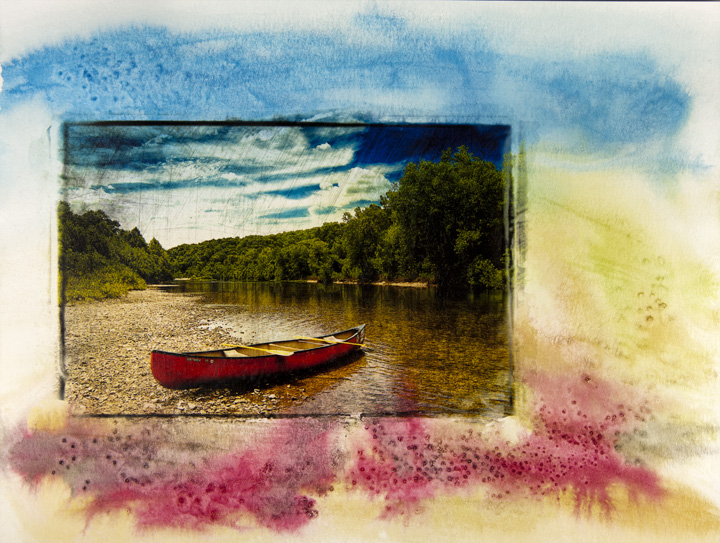
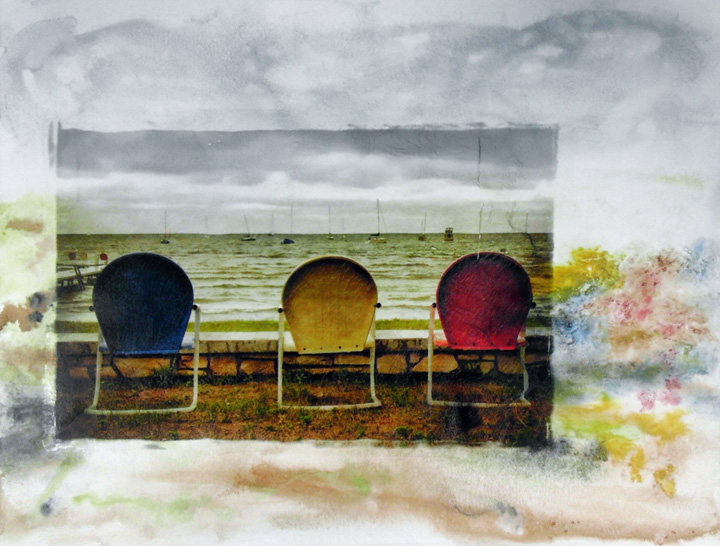
SOLD! 11x14 Mixed Media Painting: Emulsion lift on watercolor painting. ©2013 Jeane Vogel Studios

My Sister’s Bay, SOLD! 11×14 Mixed Media Painting: Emulsion lift on watercolor painting. ©2013 Jeane Vogel Studios

Mixed media painting, my newest body of work, is inspired by a need to expand the photograph beyond what we can see into what we can imagine.

In fact, when I think about it, that’s the basis of every piece of art I create. I want to know what else is there to see, to understand, to experience?

I’ve discovered that some patrons want to understand this unique process. Here goes:

I start by photographing the world that inspires me. It might be water. It might be an abandoned historic building. It might be a small portion of a flower. That it inspires me is the key.

I live with the processed image for while. What lives within it? What secret can it tell? What does it want me to know?

When I’m ready to paint, I create a watercolor palate to match, complement and enhance the image. I fill a sheet of watercolor paper with paint. The abstract painting is then dried, flattened, finished and prepared for the final step…

The EMULSION LIFT. This is the most difficult to explain to someone who has not studied photography. It might seem magical… or simply impossible. It’s a photographic process, so basically, it’s chemistry!

I copy the image onto a piece of 8×10 transparency film — a really big slide. Film has two parts: an acetate carrier and the photo-sensitive emulsion on top of the acetate that actually makes the image. The emulsion is microscopically thin, maleable, easily scratched and impossible to handle. That’s why we need the acetate to put it on.

Carefully, and chemically, I separate the emulsion layer — the actual image — from the acetate backing and fuse the emulsion to the watercolor painting, hoping I do not tear it, smear it, mangle it, or place it wrong.

But the magic isn’t in the process. It never is. Art is work. Of course I love it, but it is still work.

The magic is in the finished work. What do you see in it? What secrets can it tell you?

How does it make you feel?

That’s how I recommend everyone to approach art. Art is not to be understood. Art is to be felt. What you do with that feeling is the next step.

Posted in Art, NewWork, Technique | Tagged , , | 2 Comments

Hiatus Over

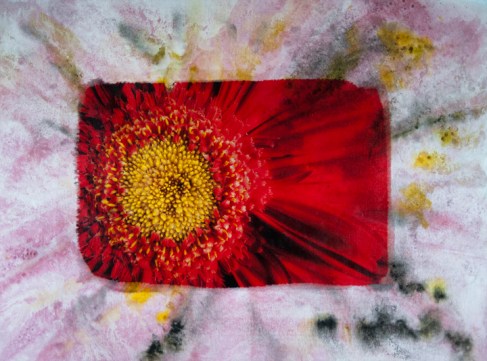
Image

Red Gerber, ©2013 Jeane Vogel Studios
Mixed Media, 14×19, $175

Life gets in the way. One minute you’re blogging along, and the next… whoa! It’s been two years!

Not that I’ve been lying around smoking unfiltered Lucky Strikes and eating bon bons. (Sorry… too much “Mad Men” lately.) I’m not ashamed to admit that the Great Recession kicked my sweet little art business’s butt into the next county. And the small shreds that were left were taken out by the April 2012 tornado.

I’m not whining, mind you. Just saying. Life gets in the way.

So, the new studio is functioning, I’m painting and shooting and making books again. New projects are in the works.

No more distractions. Hiatus over.

Posted in Art Saves Lives, NewWork | Tagged , , | Leave a comment

>Film Purists! Feh!

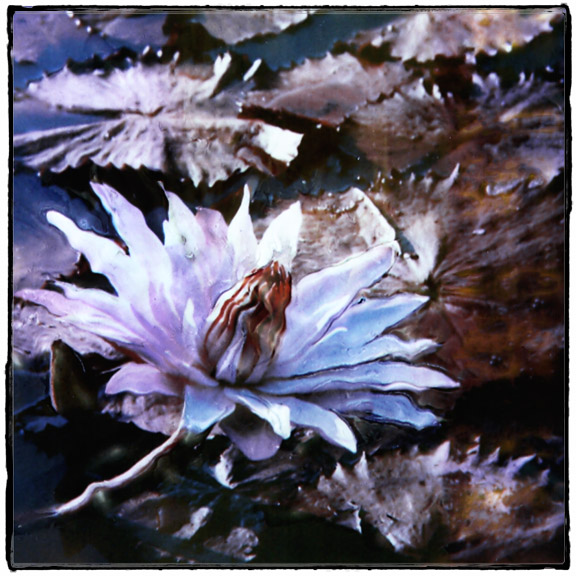
Water Lilies #1, Polaroid Painting, ©2011 Jeane Vogel Studios

>

Being an art fair artist means that I talk to a lot of people about art. A LOT of people. Literally thousands of people.

Some are knowlegable about art. Most are not. All deserve my attention. I believe we learn from every conversation — even if I’m annoyed at the time.

A handful just want to impress me with their “superior” knowledge.

Those conversations go something like this:

Man (Sorry, but it’s ALAWYS a man): I see you’re using film. That’s great. I only use film.

Me: Yes, this body of work uses a discontinued Polaroid film. I love the characteristics of the film, but I work in digital too.

Man: Oh, digital isn’t real photography. I’m a purist. I only shoot film. Anyone can shoot digital.

Me: A purist? Really? (I’m getting annoyed by this time.) I would think if you’re a purist that you would coat your own glass plates and not shoot film. Film is so 20th Century. A PURIST would shoot glass plates.

Man: (reaching for his cell phone) Sorry. I gotta take this.

For years I’ve been saying, rather sarcastically, that purists would coat their own glass plates. It’s the arrogant photographer who thinks that his or her medium is the PURE one and rest of us are lazy hacks. It’s the vision –and the ability to communicate that vision — not the tool, that is important.

Imagine my surprise when I heard Webster University Photography Professor Extraordinaire and acquaintance Bill Barrett use EXACTLY THOSE SAME WORDS in a discussion about “purists” using the now defunct Kodachrome film during an interview on the local NPR show yesterday.

“Purists would coat their own glass plates,” he said.

Now, Bill and I haven’t had a chance to spend a lot of time together, and I don’t think we’re ever heard the other say this line.

My only conclusion: great minds think alike! Thanks for the affirmation, Bill!

And if you’re in St. Louis, please go to the May Gallery at Webster to see the Kodachrome exhibit the university put together from the last batch of processed film shot by students and faculty. Buy the book. Support the next generation of artists who dare to work in photography. And support their teachers.

Posted in Art, NewWork, Polaroid, Soap_Box | Leave a comment

>Where IS Feminist Art These Days?

>

Summer Garden, 9×11 inches, Mixed Media, ©2011 Jeane Vogel, $75.

Beware. I drop the “F” word a lot. I grew up hearing it was a dirty word but I never understood why. It seemed to me to be the most natural thing in the world.

Feminism.

How could Feminism be offensive? It’s a word that proclaims independence and equality and respect for all women.

Except to many people it doesn’t mean any of those things. In the ’70s it meant that women and men would have to share bathrooms. And women would have to go to war, or work, or not have a chance to be mothers and ultimately fulfilled as women. Oh, F…. Opps. Almost dropped that other “F” word. That’s generally how I respond when I heard those lies that we told to defeat the Equal Rights Amendment — the Constitutional Amendment that would guarantee equal rights for women.

Instead, what feminism meant to my generation of women — Baby Boomers — was reproductive freedom, and equal pay for equal work, and access to education and jobs previously available only to men, and credit in our own names — in fact the right to keep our own names. We hoped for the chance to go to work and not be sexually harassed. We dreamed of the day our minds would be respected, even if we had great breasts and long slender legs… or especially if we didn’t.

The artists among us put these ideals into our art. The artists did what artists always do: they pushed the boundaries of “traditional” art to raise our consciousness and our hopes. Feminist art demanded reforms in the way we thought about women’s abilities and women’s bodies. They lifted the veils of modesty that chained women to myths of helplessness and dependence.

It’s 40 years later, and I’m left wondering what feminist art is now. Have we come very far?

I’m so grateful to have been able to attend the 2011 Women’s Caucus for Art National Conference. It was a delicious orgy of women and art and ideas and challenges to push beyond individual limits. Breathlessly huddled over coffee or beer we asked: What can we do next? How can we do it? Who can we collaborate with to accomplish it? Where will it take us?

On the edge of inspiration was a nagging feeling that feminism, and feminist art, has lost its power and impact. What is feminist art now? What does it mean to women born after Roe v Wade gave women the right to control their reproduction?

We saw a lot of “feminist” art at the national conference. I saw some interesting work, some not. In 2011, is feminist art simply work that has been produced by women? Is it a way to rehash middle class injustices of childhood? Will it change the world? Will anyone ever notice?

Frankly, I was disappointed in the energy and spirit of younger women artists as they presented work they named feminist. Some explored the same themes that challenged their mothers and grandmothers. Do young women of today face the same misogynist  obstacles that we did when Richard Nixon was President? Sometimes. But the 2011 responses seem to be turned inward and personal and mostly consumed with body image.

What have we done to our daughters? Feminism means it’s ok to look the way you look? Well, sure it does. But is that all?

A common feminist theme – reproduction freedom – was nowhere incorporated into new work I saw. Instead, there were throwbacks to visuals of the 1950s. What are younger women trying to tell us? Are they romanticizing those years of emotional and suburban captivation for women?

And when I turn the mirror on myself, I have to ask: Where is my feminist art? Am I championing women or I am falling into self-indulging visual self-stimulation too?

I’m challenging myself. I’m challenging you. I’m not part of that younger generation making feminist art. I’m part of the older group. It’s not my turn to lead the way anymore, but there are still too much for us to say in our art that can turn a head… or a heart… to benefit our sisters.

Let’s create art that will change our world.

This blog was originally published by Jeane Vogel in the March 2011 WCA-St. Louis Newsletter.

Posted in Art, Politics, Soap_Box, Women | 2 Comments

>Working in Series

>Whenever I teach a photography workshop to more advanced students, I encourage them to work in series — to create works with a common theme or subject matter.

Most think this is easy and silly. So what? Who wants to see 12 pictures of the same thing?

Then I tell them: write out your ideas and research your themes before your shoot.

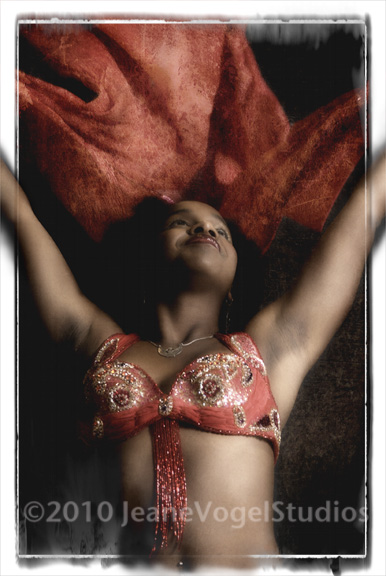
“Sacred Movement #3,” ©2011 Jeane Vogel Studios

What? We’re photographers, they yell! We shoot what we see.

Ugh. What’s wrong with this picture (pun intended!)? What’s wrong is that the photographer is passive if she’s only shooting what she sees or finds interesting. That’s one of the reasons that some people don’t see photography as “art” — and are not shy about telling me so!

BE ACTIVE in your art. There are lots of ways to elevate a “snapshot” to the realm of art. One way is INTENTION.

Photography is communication, like any other art form. The artist has something to SAY. Before saying it, she needs to know what it is she wants to impart. That takes thought, time, research and lots and lots of work.

Whether the message is obvious and simple, or conceptual and complex, the best work in series will be thoughtful.

Last Friday, my newest work “Sacred Movement” was unveiled at Third Degree Glass Factory in St. Louis. It started about 10 months ago with a conversation. One of the owners of a belly-dance school and professional troupe approached me about working together to get images of the women dancing. I could use them any way I wanted and I agreed to do some publicity stills for them. Win-win. I had no previous interest in belly dancing, other than it was beautiful and fun.

I started my research. I played with ideas in my head.

aalim-10web_med
“Sacred Movement #10,” ©2011 Jeane Vogel Studios

Within months, about the time we scheduled the shoot, some ideas had formed. The research jelled.

Belly dancing is a woman’s dance for women. It’s not supposed to be sexual. It’s not supposed to be for men! It’s for women. It’s also mystical and holy. It reveals and conceals. There are layers and layers and layers of meaning.

There was my concept! I wanted to reclaim this dance for women. While I rarely use a lot of digital work, “Sacred Movement” needed layers and layers of textures and colors, which I could do with digital painting. The result is an evolving work I’m delighted with.

Not everyone gets it. Some just see pictures of women dancing. That’s ok. I hope they see GOOD pictures of women dancing.

Those who do “get it” rewarded me with interpretations that added to my original concept and enhanced the series with satisfaction that comes from the sharing of ideas. The whole series is here:http://vogelpix.com/special-series-fine-art/sacred-movement/

Artist statement:
SACRED MOVEMENT
A Tribute to Women, Dance and the Feminine Divine

Like a curtain being pulled aside, revealing another world. That’s how Jeane Vogel’s work has been described.

In Sacred Movement, Jeane reveals the feminine divine through the fluid grace of the dancer — specifically the belly dancer.

A uniquely feminine dance, belly dancing has been sexualized by the West. Originally, it was a tribute to the Goddess — a prayer, a gratitude, a celebration.

In Sacred Movement, Jeane reclaims the intent of the dance and rededicates it to feminine divinity. These photographic images have been digitally painted to create layers and layers of texture and color, unveiling the secrets of the dance. The hand-deckled edges are suggestive of frayed fabric, fringes and baubles. The artist’s intent is to create images that are simultaneously light and complicated, intense and accessible, layered and simple. She invites you to approach the art as you would a relationship. How does it make you feel? Does it evoke a memory? An emotion? A call to action?


Many thanks to the professional dancers and advanced students of Aalim Dance for being partners in creation of this evolving work.

Posted in Art, NewWork, Photography, Technique | 1 Comment

An Unexpected Lesson

When I teach, I never know what the lesson will truly be.

That’s the gift teachers are given, I think. We plan, but the lesson might be something far more profound.

Last week I was in Atlanta as Artist in Residence for a national mental health organization. I teach on the Youth Track, 13-25 year olds. I’m there, techically, to teach a photography workshop, but it’s really a three-part session on self-expression. The work produced each year knocks my socks off.

The first session is shooting. We find an area near the hotel that will provide the richest amount of content for the photographers. This time it was Centennial Olympic Park. Coming back from the park, I was in the rear of the 21-person group walking with a straggler. As we neared the hotel, we saw a loud, energetic picket line of workers protesting low wages.

“This is my first protest!” The student, a high school junior from Montgomery, AL, was beside herself with excitement. She ran to document it with the few shots left on her camera.

Flushed and animated, she returned. “Do protests work?”

“Sure,” I said. “Peaceful, powerful protests work all the time. The ones that work are the ones that have clear goals.”

“Huh?” She had no idea what I was talking about. I tried to make it more personal.

“Do we have Jim Crow laws anymore?” I asked. I thought a light bulb of instant understanding would go off in the head of this African-American girl from Montgomery. The civil rights movement was seminal to forming everything that I am as a person, as an artist, as a political being. It’s a touchpoint. Sometimes I forget that not everyone thinks the way I do and that it was 50 years ago. Those events are history to this child. Ugly history. Maybe even boring history.

“Jim Crow? What are those? I don’t remember.”

Really? A girl from Montogermy, AL, didn’t know what Jim Crow laws were? I couldn’t decide if that was great or tragic.

I tried again: “Are there separate water fountains for blacks and whites anymore? Can you and I go to the hotel restaurant and have a meal together?”

She was starting to understand.

“Protests work,” I said. “You are growing up in a different world than I did because of peaceful protests.”

I got a look of “wow.” We spent the next 10 minutes talking about the power of peaceful protests. We talked about the Montgomery Bus Boycott, the Freedom Riders who came from all over the country to protest Jim Crow, Dr. King, the sanitation worker’s strike that cost Dr. King his life. We talked about what she might want to change in her life.

That a peaceful group can band together and work tirelessly to change a wrong turned out to be the lesson of day. For one girl. From one teacher.

Art Saves Lives.

Posted in Art Saves Lives, Civil Rights, Politics, Soap_Box, Stories, Workshop | 1 Comment

>Using Art to Change the World

>Is there a more versatile method of communication than art?

Art can tell a story, retrieve a memory, provoke an argument, inspire a movement.

Art saves lives. Art can change the world.

http://www.youtube.com/get_player
My dear friend and conception artist/sculptor Ilene Berman likes to say, “If art doesn’t change the world, what’s the point?” Indeed. Her project, NODhouse, is calling attention to inequities in art allocation resources in an area that is deemed “undesirable.” Ilene’s art will change this part of the world.

Dare to Touch the Face of God
is another of those projects. It’s my most ambitious project and, frankly, I need your help.

DTFG (it’s too long to spell it out all the time!) is my response to the vitriol, hatred and fear mongering that seems to ramp up everyday because it’s easy to victimize and demonize people we don’t know or understand.

For a thousand years in Europe, if something went wrong, you could be sure it was the Jews’ fault, or the Gypsy’s. We know how that ended.

Today, it’s the Muslim’s fault. Yes. It’s the same song. It’s the same root cause. It’s the same fear.

It has to stop.

But it’s not just Islam that is feared and misunderstood. We don’t really talk about religion. It’s not polite. We don’t know much about other people’s faiths. We don’t understand. Our prejudices are under the table.

Polygamists are creepy pedophiles. Catholics want a lot children and do whatever they’re told by the Pope. Buddhists are godless. Pagans eat babies. Jews are rich and controlling. Amish are backward but quaint. Atheists are communists.

Muslims are terrorists.

Don’t tell me you haven’t heard this. I know you have. And worse. And we can reject every one of them… and still be afraid. Why? Because it’s not the stereotypes that do the most harm. It’s our inability to think of members of different religions as people. And then to respond to them that way.

Dare to Touch the Face of God
is a project to put a human face on faith. The series is intended to capture to breadth of religious understanding among people, and to further the definition of God. My goal is to put a human face on faith traditions or practices we might not understand or know about. Put a person — famous or not — with a practice or an idea. My subjects will be people who are willing to work with me to communicate their faith through a photograph.

Simple. Human. Delicate. True.

The project has been accepted as a Kickstarter project. Kickstarer helps innovative art projects secure funding from ordinary people who want to support the arts.

That’s where you come in. Your support of this project is essential to it’s success. Thank you!

Have an idea for a subject? I’m looking for your input on that too. Send me a private message or use the comment section to start a conversation. A separate website, DareToTouchTheFaceOfGod.com will be live by Oct 6.

Posted in Art, Art Saves Lives, Ethics, NewWork, Politics, Soap_Box | 4 Comments

>Oh Sure! Anyone Can Do This!

>
Some art collectors like to denigrate photography.

“Anybody can take a picture,” I’m told.

You cannot image how many times I’ve heard this. It’s said to my face because the patron thinks I’m being paid a compliment! It’s said as he or she is looking at my Polaroid Paintings, where I use the emulsion as a painting medium. Because I’ve altered the image by hand, the work has been elevated to the realm of “art.” I’m no longer “just” a photographer, but an artist.

“You’ve almost made art here!” one woman gushed in appreciation. I took a breath. Yeah, I thought. I came THIS close!

Can anyone take a picture? Sure. Can anyone pick up a brush and paint? Sure. Doesn’t mean it’s going to be art.

It’s such a narrow definition — art. And made more complicated in the field of photography because of the easy availability of cameras. Everyone has one — or three. Pull out a phone, and pull out a camera. People have stood in my booth at art fairs and scrolled through dozens of “great” pictures they took. They’re saying to me: See? I can take good pictures too! We’re part of the same club.

Maybe we are. It’s a pretty big club and they’re lots of room for everyone, but that doesn’t mean all the work is the same.

I will agree with the idea that “anyone can make a picture.” But that’s not the same thing as creating a work of art in the medium of photography.

“Is photography art?” is an argument as old as the medium itself. Every generation takes it up again and makes new rules. In the digital age, there are some who call themselves “purists” who insist that if the image is not captured on film and developed in the darkroom, then it’s not “real” fine art photography.

Oh, feh! I’ve seen plenty of crappy work come out of the darkroom. Honestly, if you want to be a “purist,” then coat your own glass plates and make images on those. If not, then shut up with the arrogance.

It’s not the tool or the substrate that makes the art (though please don’t take iPhone pictures and call them art. I know — that’s my arrogance — but please!!!!) Then what is it?

It’s the ability to take a great photograph… and then do it again.

It’s the courage to try something new, and learn from it.

It’s the thoughtfulness to create an image in your imagination, then transfer that image to film or paper or sensor.

It’s the knowledge of how to transfer your ideas to paper or film, without guessing or hoping for the best, but knowing.

It’s the deliberate and purposeful communication of an idea or a feeling or a mood with an image … without adding anything words or explanations.

It’s the commitment to create a body of work, in your vision, that is recognizable as yours.

It’s the confidence to let your work speak for itself, and allow the viewer to add his or her own interpretation.

Art takes time. Art takes thought. Art takes labor.

There’s a reason it’s call a work of art.

Arcadian Dreams #12, Infrared photograph ©2010 Jeane Vogel. All rights reserved.

Posted in Art, Infrared, Nature, NewWork, Photography, Soap_Box | 8 Comments