>
>Dear fellow & sister artists,
In February we all watched in horror while much of the Australian province of Victoria went up in flames. While that was horrible enough, it got worse: the town of Marysville, Victoria, is an artist’s haven. Every gallery, studio, wooden sculpture garden, brush, canvas, oil, pen — everything went up in flames. Hundreds of thousands of pieces of art and every art space is gone. All. Gone. In a blink of an eye. There was no time to save anything.
We have a chance to help. A sister artist, Wyn Vogel (no relation) and I have joined together to create ART – “Art Recovery Together” Wyn lives in Brisbane and has lots of contacts in Marysville. She has contacted the local art group, the Yarra Valley Arts Council (YVAC) to find out what artists need. They need EVERYTHING. The YVAC is helping us coordinate.
For three months, from April 1 to June 30, Wyn is turning over her website to collect art for sale, the proceeds will help buy art supplies, replace equipment, anything they need that helps artists start working again.
We need your help and your donations. The donating artist will email me with a jpg, sale amount, how much of sale amount will benefit ART, (at least 50% please!) and the estimated shipping cost (to US and to AU). We will put them on the web site and publicize the on-line event. If your piece sells, we will contact you with information on shipping. All family-friendly work is requested.
Basic info:
1. Jpg files should be about 900k
2. Send up to 5 views of each work. Fewer is better but send what you need to show the work
3. Include your name & contact information, website, size and medium of work
4. Short bio (no more than 3 normal sentences). You can include your picture.
5. Send all information to jeane@vogelpix.com
This project has been backed by the Regional Arts Council of St. Louis and by the Yarra Valley Arts Council in Australia. Both Wyn and I are putting our reputations behind it, for what that’s worth. Wyn’s work can be seen at http://www.wynvogel.com.
This has taken Wyn and me a couple of months (mostly Wyn!) to jump through hoops and get permissions to proceed. It’s not too late! Thanks for any help you can give our fellow and sister artists who have lost everything — including their art. Let’s get them creating again.
Please send this to EVERYONE who can help. Feel free to contact me with any questions.
Thank you!
>I finally did it. I opened the Etsy shop.
If you don’t know about Etsy, I encourage you to explore it. Etsy provides artists a venue to display and buyers to discover small hand-made treasures. Most of the work there is inexpensive, ranging from $10 – $100.
It’s the place to go for a special gift. It’s the place to go to support an artist. It’s the place to go to buy hand-made.
I’m happy to see our culture returning to an appreciation of fine hand-made things. I’ve given hand-made gifts for years: note cards, pottery, knit scarves. Most people appreciated them — some didn’t. The ones who didn’t thought I was being cheap. The ones who did loved that I spent time creating something just for them.
When I want a gift, I love buying finely crafted hand-made gifts. Of course, not all hand-made is created equal but the best hand-made
Every other generation or so, as a people we return to our roots. We pick up the basket reeds and clay lumps amd charcoals and needles and begin to create for ourselves again. I’m sorry that sometimes it takes an economic downturn for us to reject all the over-packaged, grossly-advertised store-bought, but I’m glad we’re getting there again.
Hand-made is special. Hand-made is holistic. Hand-made is sustainable.
>
Is there a connection between artists being told what to do and the banality of most art seen in public places in the US? Bear with me here.
The connection might be called Unsolicited Advice.
I seem to get it all the time. Strangers walk into my studio, look around. “You know what you should do…” Then it begins.
A fellow artist walks into my studio. “You know what you should be doing …?” No, you do that. That suggestion has nothing to do with my work.
I’m not saying that I don’t like input and advice. In fact, I often ask for it and get terrific responses. Sometimes I don’t like the suggestion, but it might give me pause and force me to understand why I’m not heeding it. (As an aside, if I need my ego fed, I ask advice from my husband. He seems to think everything I do is wonderful. How cool is that?)
What I truly don’t understand is why do people insist on telling me what I should be doing. Do I look incompetent? Do I seem confused or aimless? Did I ask for advice? Am I your student?
Unsolicited Advice. It makes you question your judgment, censor your thoughts, keep your work safe.
Or, are you telling me what art to produce because you don’t like my work? Don’t understand it? It’s not what you expect? Ok. Tell me that instead.
A Buddhist friend tells me that I get so much unsolicited advice because I’m always giving it. Well, that should stop, shouldn’t it? OK, I’ll work on that, but there’s something more.
Do we really want all art to look alike? Are we so narrow or limited or lazy or stupid that we have to be spoon fed only paintings of little girls holding a bouquet, or a sailboat on the sea, or a field of sunflowers. I’ve created art with all these things, but this is all we can do? Can’t we create something that forces a viewer to spend more than 5 seconds with it before moving on?
Art should spark a conversation, link to another idea, inspire an action, even just solicit a smile. I’m not saying that every work produced has to be important or controversial or political. Our art should not just fade into the wall.
Take a look around at your bank, your hotel lobby, your dentist’s office. Do you notice the art? If not, ask why it’s there. I don’t think we really want everything the same. We don’t want to be told what we should be doing.
>Those of us who began studying photography in the dark ages (read: darkroom ages) had this adage drilled into us. f8 and be there!
It means that the photographers who get the “best” pictures are those who have their camera set on a medium aperture (f8) to compensate for focusing errors (no auto-focus in those days), and are there — at the spot they are supposed to be.
What it really means is, “be prepared.” There’s also an element of luck involved. Now, I’ve was a Girl Scout until I was kicked out at 13 (another story) and I’ve been a GS leader for 8 years. I’m a mom. I know all about “be prepared” and the value of “luck!”
I started thinking about what “f8 and be there” could mean for all artists today. It struck me that “f8 and be there” is the old photographer’s shorthand for daVinci’s 7 Virtues of Life for Artists.
Note that DaVinci didn’t call these the “virtues of artists” but the virtues of LIFE for artists. I think what he is telling us is that talented artists who do not live in the world, experience the world, interact the world, comment on the world and struggle to fix the world are artists who are wasting their talent on self-indulgence and ego.
I’ve had daVinci’s 7 Virtues, with my interpretations, posted in my studio for years:
Curiosita — an attitude of curiosity of continuous learning. It’s the “what, when, where, why & how?” of living.
Dimostrazione — an ability to learn and to test by knowledge by experience. Have an experimental nature.
Sensazione — a development of awareness and refinement of sight and other senses. Be alert. Be aware. Use all the senses to experience the world.
Sfumato –think the way you paint. Overlay. Blend. Have a tendency to embrace and accept uncertainty, ambiguity and paradox. Be a free thinker.
Arte/Scienza — a develop a balance between science and art, logic and imagination. Use the whole brain. Think. Create.
Corporalita — have a calculated desire to achieve poise, fitness and ambidexterity. Be physical. Take action.
Connessione — recognize that all things are connected. Life, art, politics, people, nature, commerce, faith.
Thanks, Leonardo.
>Anyone who has been to Florence or Rome, or who stayed awake during the Art History class slide shows, has seen the splendor that was created during the height of Europe’s golden age for artists. The 15th and 16th century in Europe was awash with money and princes and aggrandizement. The work was bold and new and demanded to be seen and discussed.
Ever wanting to best their peers, the elite hired hired artists, kept them on the payroll and commissioned grand work that still takes our breath away 500 years later. I haven’t set foot inside the Medici Chapels since 1982, but given the chance I will gush on for 20 minutes about the detail and beauty and exquisite workmanship of the floor-to-ceiling mosaics.
It was an era of full employment for artists. Patrons paid, artists created.
Not that all was good, of course. Your patron had to like the work you created for him. Many a tortured artist was forced to produce pedestrian art to please the master. If not, you might be discharged — permanently.
Diego Rivera experienced the pain of the displeased Patron in the ’30s when Rockefeller destroyed the commissioned mural because it was too revolutionary. Rockefeller knew who Rivera was, right? Did he think that Diego would paint a mural of the benign industrialist? Or maybe dogs playing poker?
There are some who believe that we have a patron system in place right now: it’s called the University. Artists teach and produce work. Some are no more satisfied with the new Patron system, than with the old. Though few art professors lose their heads if they get a negative review.
So here’s my challenge. Let’s bring back the Patronage system. Let’s be active in seeking out matches for artists and collectors, companies and institutions. Let’s be generous with our knowledge of each others’ work. Let’s encourage businesses to take down the anonymous, boring, beige mixed media abstracts and pretend-watercolors of sailboats, and replace them with work that will make people stop and look — and want to come back to the business to look again.
The Patronage system filled 15th century Europe with beauty and majesty and work worth of comment. It’s time we do the same in 2009 everywhere.
>
Everyone body does it once in a while: phones it in. Creation become mundane. Even work we love can become boring. Maybe I’m feeling sick. Maybe I’m feeling bored. Maybe I’m burnt out. Maybe I’m resentful of the work the client wants.
Maybe I’m just lazy.
I know that sounds harsh, but let’s call it what it is. It hits all of us once in a while. We let it slide. It’s good enough. We hope it doesn’t show.
Of course it shows. All of us are judged by work. Our most recent work. There’s truth in the old saying that we’re only as good as our last effort. The old stuff might be great, the new stuff is lackluster, but nobody will notice because we’re successful or well-known or … whatever.
I recently read an interview that drove this point home to me. A local reporter, long relieved of duties by layoffs, produced a freelance piece for a small paper. I know this person and the writer is competent. The article I read was not. The questions were common, the writing was lazy. The reporter phoned it in. It was good enough. When I thought about it, I realized that everything I’ve read by this writer lately has been far below what we used to except. Maybe the writer thought no body will notice.
I think lots of people notice.
As soon as the thought “it’s good enough” pops into my head, I know I have to resist the temptation to believe it. As soon as I realized I’m “phoning it in,” I know it’s time to look at why.
Why is it “just good enough?”
Is the concept not good enough? Start over.
Is the client not paying enough? Learn from that and restructure the pricing — next time.
Do I think I’m not talented enough to deliver the work I imagined or promised? Try it again. “I can’t” generally means “This us too hard. I don’t want to try.”
Am I bored? Too bad. Do it anyway.
We all can’t be the best, but there’s no excuse for laziness. There’s no excuse for phoning it in.
>
Photographers aren’t taken seriously as artists by many people.
My work often doesn’t look like photography, so patrons confide in me: “I don’t really like photography. Any body can take a picture.” Sometime they add, trying to be complimentary: “But YOUR work. That’s art. You really had to do something.”
I don’t like pitting my work against other photographers or artists. I’d rather try to broaden the patron’s view of art to include traditional photography.
It’s true, anyone can take a photo. Seems that everyone does. An artist, though, creates a comprehensive body of work. An artist creates a distinctive style and captures his or her vision on film or sensor. An artist communicates. One or six nice pictures does not an artist make.
That being said, I like to push my medium a bit beyond the obvious. Most people think that photography captures a moment in time. I disagree. A snapshot captures a moment in time. A photograph captures a mood or emotion. It tells a story. It evokes a memory. It provokes a discussion. The moment in time is almost irrelevant.
I am especially fond of photographic processes that expose a part of our world that we cannot see with out eyes. I want to produce work that asks for a relationship — demands a few minutes of your time and maybe even gives you something new every time you approach it.
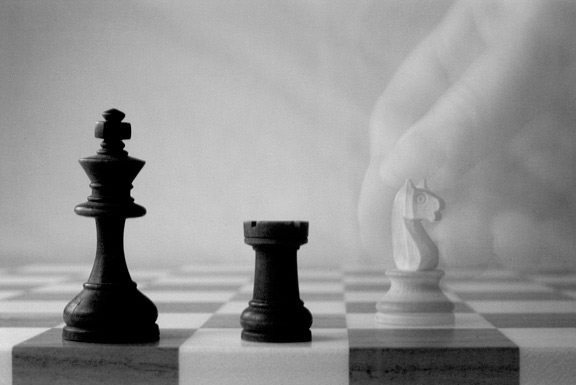
My newest work — the Game Series — combines both goals. The set-ups take a long time, so I’m shooting each one in hand-altered Polaroid and in infrared. I’m delighted by how different each is, even with the same subject matter.
Does the Games Series demand your time and give you something new? You tell me.
>
Imagine the room filled with art fair artists. Imagine we’ve lost faith in ourselves and we fearful of what we face in the next months as we travel to fairs, set up displays and desperately, hopefully look to each person who comes by.
There’s a different feeling this year, isn’t there? The last couple of years have been rough sometimes, and that was before the bottom dropped out of everything.
As bad as things are for some people — and I truly believe that we have to do everything we can to help each other — it’s not bad for everyone. Sure, the media is hyping us in to a disaster frenzy, but let’s put things in perspective: There’s always a market for good art.
As I head into this new season, there are a couple of things I’m going to keep in the front of my head:
Will this be an easy season or a challenging one? Who knows? Not every artist will have the same experience. I’ve had terrific shows when my neighbor didn’t make expenses. This year, we have to use all the skills we have.
Being a working artist is a lesson in Darwinism: The strong survive. The survivors adapt. The ranks thin and produce better offspring. In our case, our offspring is better art.
I’m not prone to “Pollyanna-ish” sentiment, but I think we have a great opportunity this year. My plan? I’m focusing on my core values: quality, integrity, attitude, graditude.